Advertisements
Advertisements
Question
Which colour of white light travels fastest in any medium except air?
Advertisements
Solution
All media except air allow red light to travel at the fastest speed.
APPEARS IN
RELATED QUESTIONS
Define refraction and state the laws of refraction.
How is the reflection of light ray from a plane mirror different from the refraction of light ray as it enters a block of glass?
How does the angle of deviation produced by a prism change with increase in the angle of incidence. Draw a curve showing the variation in the angle of deviation with the angle of incidence at a prism surface.
An object is viewed through a glass prism with its vertex pointing upwards. It appears to be displaced upward. Explain the reason.
Fig 4.31 below shows a light ray of single colour incident normally on two prisms A and B. In each case draw the path of the ray of light as it enters and emerges out of the prism. Mark the angle wherever necessary.
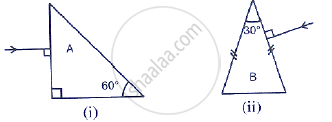
What is meant by the refraction of light?
Express the refractive index μ of a medium in terms of the velocity of light.
In what condition a prism is said to be in the position of minimum deviation? What is the direction of the refracted ray inside the prism in this condition?
A ray of monochromatic light is incident from air into a glass slab. Draw a labelled ray diagram indicating the change in its path till it emerges out of the slab. In the diagram, mark the angle of incidence (i) and the angle of refraction (r) at the first interface. How is the refractive index of glass related to the angles i and r?
A coin placed at the bottom of a beaker appears to be raised by 4.0 cm. If the refractive index of water is 4/3, find the depth of the water in the beaker.
