Advertisements
Advertisements
Question
A coin placed at the bottom of a beaker appears to be raised by 4.0 cm. If the refractive index of water is 4/3, find the depth of the water in the beaker.
Advertisements
Solution
Let Real depth = x
∵ Refracture Index, μ = `"Real depth"/"Apparent depth"`
⇒ `4/3="x"/("x"-4)`
⇒ 4x − 16 = 3x
∴ x = 16 cm.
APPEARS IN
RELATED QUESTIONS
Draw a ray diagram to show the refraction of a monochromatic ray through a prism when it suffers minimum deviation.
A ray of light passes from water to air. How does the speed of light change?
Which of the following is the best experimental set-up out of the four shown for tracing the path of a ray of light passing through a rectangular glass slab ?
Select from the following the best set-up for tracing the path of a ray of light through a rectangular glass slab:

(A) I
(B) II
(C) III
(D) IV
Draw a diagram to show the splitting of white light into its constituent colours.
Which colour of light travels fastest in any medium except air?
How does the deviation produced by a prism depend on the refraction index of its material.
Draw ray of light bending towards the normal while passing from air to glass. Label your diagrams.
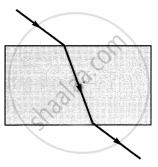
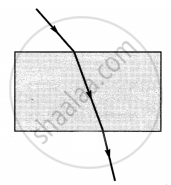
The path of a ray of light coming from air passing through a rectangular glass slab traced by four students are shown as A, B, C and D in the figure. Which one of them is correct?
 |
 |
 |
 |
| A | B | C | D |
A ray of light strikes the surface of a rectangular glass slab such that the angle of incidence in air is
- 0°,
- 45°.
In each case, draw a diagram to show the path taken by the ray as it passes through the glass slab and emerges from it.
