Advertisements
Advertisements
Question
Express the refractive index μ of a medium in terms of the velocity of light.
Advertisements
Solution
The refractive index ‘μ’ of an optical medium is defined as the ratio between the velocity of light in vacuum divided by the velocity of light in the given optical medium. Thus,
`µ="Velocity of light in vacuum"/"Velocity of light in the given optical medium"`
RELATED QUESTIONS
Explain how spectrum is formed.
Explain how the formation of a rainbow occurs.
A student traces the path of a ray of light passing through a rectangular glass slab and marks the angle of incidence i, angle of refraction r and angle of emergence e, as shown.
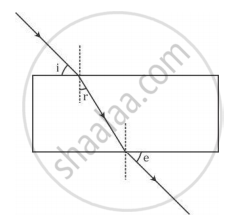
The correctly marked angle(s) is/are
(A) ∠ i only
(B) ∠ e only
(C) ∠ r only
(D) ∠ i and ∠ e
How must light travel out of a substance if it is not going to be refracted?
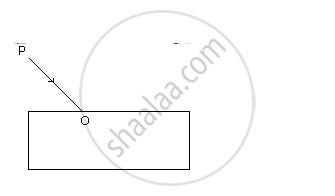
In the fig., PO is a ray of light incident on a rectangular glass block.
(a) Complete the path of the ray through the block.
(b) In the diagram, mark the angle of incidence (i) and the angle of refraction (r) at the first interface. How is the refractive index of glass related to the angles I and r?
(c) Mark angle of emergence by the letter e. How are the angles i and e related?
(d) Which two rays are parallel to each other? Name them.
(e) Indicate in the diagram the lateral displacement between the emergent ray and the incident ray.
Why does a fisherman aim at the tail of fish during spearfishing?
After a robbery, if a window has been broken, there will be tiny particles of glass. Some of these will be found at the scene of the crime and some may be caught in the thief’s clothing. If the police can prove that these particles are identical, they have a strong case.
A method of doing this is to suspend the particles of glass in a special liquid. Light of a single colour is thrown through the liquid and the particles viewed through a microscope. The temperature of the liquid is then slowly altered. This alters the speed of light through the liquid (i.e., it alters the refractive index). At one particular temperature, the particles of glass disappear. It this happens at the same temperature for both sets of glass particles, they probably came from the same broken pane of glass.
Complete and copy the diagram to show how light bends when it travels from the liquid to the glass and back to the liquid, If the light slows down in the glass.
The diagram below shows two parallel rays A (Orange) & B (Blue) incident from air, on air-glass boundary.

- Copy and complete the path of the rays A and B.
- How do the speeds of these rays differ in glass?
- Are the two refracted rays in glass parallel? Give a reason.
