Advertisements
Advertisements
Question
Write a relation between the angle of incidence (i), angle of emergence (e), angle of the prism (A), and angle of deviation (d) for a ray of light passing through an equilateral prism.
Advertisements
Solution
i + e = A + d
APPEARS IN
RELATED QUESTIONS
The speed of light in glass is 2 × 10⁵ km/s. What is the refractive index of glass?
How is the reflection of light ray from a plane mirror different from the refraction of light ray as it enters a block of glass?
A light ray in passing from water to a medium
(a) speeds up
(b) slows down. In each case, give one example of the medium.
The critical angle for glass-air is 45° for the light of yellow colour. State whether it will be less than, equal to, or more than 45° for (i) ref light, (ii) blue light?
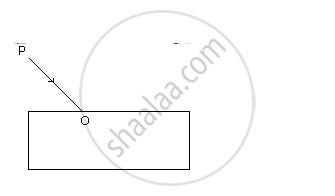
In the fig., PO is a ray of light incident on a rectangular glass block.
(a) Complete the path of the ray through the block.
(b) In the diagram, mark the angle of incidence (i) and the angle of refraction (r) at the first interface. How is the refractive index of glass related to the angles I and r?
(c) Mark angle of emergence by the letter e. How are the angles i and e related?
(d) Which two rays are parallel to each other? Name them.
(e) Indicate in the diagram the lateral displacement between the emergent ray and the incident ray.
Name the phenomenon responsible in the following case:
Twinkling of stars
Why does the sun appear bigger during sunset or sunrise?
A ray of light moves from a rare medium to a dense medium as shown in the diagram below. Write down the number of the ray which represents the partially reflected ray.

A ray of light strikes the surface of a rectangular glass slab such that the angle of incidence in air is
- 0°,
- 45°.
In each case, draw a diagram to show the path taken by the ray as it passes through the glass slab and emerges from it.
