Advertisements
Advertisements
Question
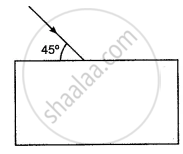
A ray of light moves from a rare medium to a dense medium as shown in the diagram below. Write down the number of the ray which represents the partially reflected ray.

Advertisements
Solution
Ray 2 shows partially reflected ray.
RELATED QUESTIONS
Explain how the formation of a rainbow occurs.
Four students P, Q, R and S traced the path of a ray of light passing through a glass slab for an angle of incidence 40° and measured the angle of refraction. The values as measured them were 18°; 22°; 25° and 30° respectively. The student who has performed the experiment methodically is
(A) P
(B) Q
(C) R
(D) S
If the speed of light in vacuum is 3 × 10⁸ ms−1, find the speed of light in a medium of absolute refractive index 1.5.
On the basis of the experiment, "To trace the path of a ray of light through a rectangular glass slab", students of a class arrived at which one of the following conclusions?
(A) Angle of incidence is greater than the angle of emergence.
(B) Angle of emergence is smaller than the angle of refraction.
(C) Emergent ray is parallel to the refracted ray.
(D) Incident ray and emergent ray are parallel to each other.
Which of the above wavelengths has a higher frequency?
Write the relation between the angle of incidence and the angle of refraction for a medium.
A ray of light OP passes through a right angles prism as shown in the adjacent diagram.
(a) State the angles of incidence at the faces AC and BC.
(b) Name the phenomenon which the ray suffers at the face AC.
After tracing the path of rays of light through a glass slab for three different angles of incidence, a student measured the corresponding values angle of refraction r and angle of emergence e and recorded them in the table given below:
|
S. No. |
∠i |
∠i |
∠e |
|
I |
30° |
20° |
31° |
|
II |
40° |
25° |
40° |
|
III |
50° |
31° |
49° |
The correct observations are:
(A) I and II
(B) II and III
(C) I and III
(D) I, II and III
A ray of monochromatic light is incident from the air on a glass slab:
(i) Draw a labelled ray diagram showing the change in the path of the ray till it emerges from the glass slab.
(ii) Name the two rays that are parallel to each other.
(iii) Mark the lateral displacement in your diagram.
A coin placed at the bottom of a beaker appears to be raised by 4.0 cm. If the refractive index of water is 4/3, find the depth of the water in the beaker.