Advertisements
Advertisements
Question
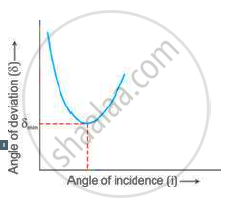
Using the curve, how do you infer that for given prism, the angle of minimum deviation δmin is unique for the given light?
Advertisements
Solution
In the position of minimum deviation δ = δmin,
i1 = i2 = i (say)
Where i1 is angle of incidence and i2 is angle of emergence.
Then δmin = 2i - A
For given prism and given colour of light, δmin is unique.
APPEARS IN
RELATED QUESTIONS
Which colour of light travels fastest in any medium except air?
Why is the ratio of the velocities of light of wavelengths 4000Å and 8000Å in vacuum 1: 1?
Trace the path of a ray of light incident at an angle of 45° on a rectangular glass slab. Write the measure of the angle of refraction, the angle of emergence and the lateral displacement suffered by the ray as it passes through the slab.
While tracing the path of a ray of light passing through a rectangular glass slab a student tabulated his observations as given below:
|
S.NO. |
∠i |
∠r |
∠e |
|
I |
60° |
40° |
61° |
|
II |
50° |
36° |
51° |
|
III |
40° |
28° |
39° |
|
IV |
30° |
20° |
31° |
The correct observations is:
(A) I
(B) II
(C) III
(D) IV
Four students A, B, C and D traced the paths of incident ray and the emergent ray by fixing pins P and Q for incident ray and pins R and S for emergent ray for a ray of light passing through a glass slab.

The correct emergent ray was traced by the student:
(1) A
(2) B
(3) C
(4) D
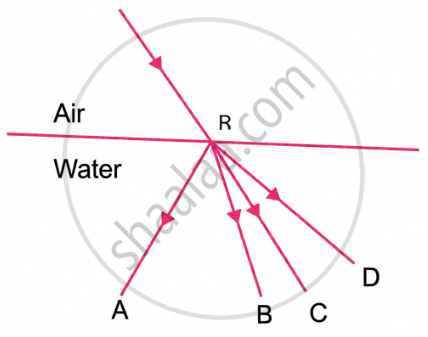
A ray of light passes from air to water. In fig., which of the ray A, B, C and D is the correct refracted ray?
Does the depth of a tank of water appear to change or remain the same when viewed normally from above?
What is the refractive index of water
The diagram shows the path of a ray of light through a rectangular glass block placed in a liquid of uniform density.

What should be the rate of the speed of light through the liquid to the speed through the glass so that there is no refraction of light at the boundaries of the glass block when the system is illuminated by the light of one colour?
A glass block is having refractive index 3/2, the light ray is incident at an angle 45°. Find the sine of the angle of, refraction inside the glass block.
