Advertisements
Advertisements
Question
In the diagram below, PQ is a ray of light incident on a rectangular glass block.

How are the angles ‘i’ and ‘e’ related to each other?
Advertisements
Solution
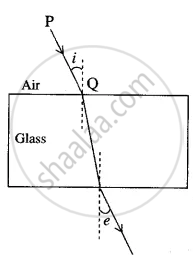
When the incident ray is undergoing minimum deviation the angle of incidence is equal to the angle of emergence, i.e., ∠i – ∠e
RELATED QUESTIONS
Explain how the formation of a rainbow occurs.
Which of the above wavelengths has a higher frequency?
Light of a single colour is passed through a liquid having a piece of glass suspended in it. On changing the temperature of liquid, at a particular temperature the glass piece is not seen. When is the glass piece not seen?
How does the angle of deviation produced by a prism change with increase in the angle of incidence. Draw a curve showing the variation in the angle of deviation with the angle of incidence at a prism surface.
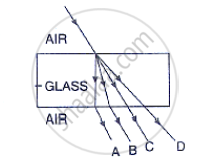
In fig 4.18, name the ray which represents the correct path of light while emerging out through a glass block.
A Water pond appears to be 2.7 m deep. If the refractive index of water is 4/3, find the actual depth of the pond.
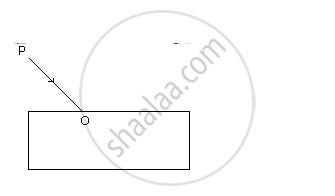
In the fig., PO is a ray of light incident on a rectangular glass block.
(a) Complete the path of the ray through the block.
(b) In the diagram, mark the angle of incidence (i) and the angle of refraction (r) at the first interface. How is the refractive index of glass related to the angles I and r?
(c) Mark angle of emergence by the letter e. How are the angles i and e related?
(d) Which two rays are parallel to each other? Name them.
(e) Indicate in the diagram the lateral displacement between the emergent ray and the incident ray.
During sunset and sunrise, the sun is seen when it is slightly below the horizon. Give reason.
Write a relation between the angle of incidence (i), angle of emergence (e), angle of the prism (A), and angle of deviation (d) for a ray of light passing through an equilateral prism.
Name two instruments of the total refracting prism in which is used.
