Advertisements
Advertisements
Question
What is lateral displacement?
Advertisements
Solution
The perpendicular distance between the path of the emergent ray and the direction of the incident ray is called the lateral displacement.
RELATED QUESTIONS
The highest refractive index is of ______.
Name the colour of white light which is deviated the most on passing through a prism.
A postage stamp kept below a rectangular glass block of refractive index 1.5 when viewed from vertically above it, appears to be raised by 7.0 mm. Calculate the thickness of the glass slab.
A student traces the path of a ray of white light through a rectangular glass slab and marks, the angles of incidence (∠i) , refraction (∠r) and emergence (∠e) as shown. Which angle or angles has he not marked correctly?

(A) ∠i only
(B) ∠i and ∠r
(C) ∠i and ∠e
(D) ∠r and ∠e
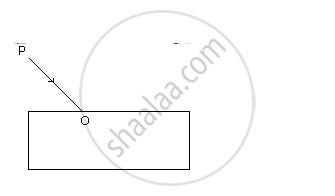
In the fig., PO is a ray of light incident on a rectangular glass block.
(a) Complete the path of the ray through the block.
(b) In the diagram, mark the angle of incidence (i) and the angle of refraction (r) at the first interface. How is the refractive index of glass related to the angles I and r?
(c) Mark angle of emergence by the letter e. How are the angles i and e related?
(d) Which two rays are parallel to each other? Name them.
(e) Indicate in the diagram the lateral displacement between the emergent ray and the incident ray.
Why is the colour red used as a sign of danger?
The figure shows two prisms A and B. A monochromatic ray of light PO is incident at the face of the prism A. Complete the diagram to show the path of the ray till it emerges out of the prism B.

Trace a ray of light incident at 30° on a surface if travelling from glass to air. What is the angle of refraction in this case? (R.I. for glass = 3/2).
Write the approximate values of speed of light in (i) air and (ii) glass. Use these values to calculate the refractive index of glass with respect to air.
