Advertisements
Advertisements
Question
Write the approximate values of speed of light in (i) air and (ii) glass. Use these values to calculate the refractive index of glass with respect to air.
Advertisements
Solution
(i) Speed of light in air = 3 × 10⁸ ms-1
(ii) Speed of light in glass = 2 × 10⁸ ms-1
Refractive index of glass with respect to air
= `"Speed of light in air"/"Speed of light in glass"`
= `(3xx10^8)/(2xx10^8)`
= `3/2`
= 1.5
RELATED QUESTIONS
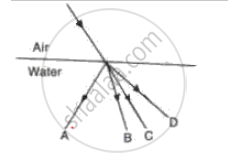
A ray of light passes from air to water. In fig. 39, which of the ray A, B, C and D is the correct refracted ray?
Light of a single colour is passed through a liquid having a piece of glass suspended in it. On changing the temperature of liquid, at a particular temperature, the glass piece is not seen.
Why is the light of a single colour used ?
Express the refractive index μ of a medium in terms of the velocity of light.
Explain briefly what causes the twinkling of stars at night.
What is the total reflecting prism?
Name two instruments of the total refracting prism in which is used.
In the diagram below, PQ is a ray of light incident on a rectangular glass block.

How are the angles ‘i’ and ‘e’ related to each other?
A ray of light PQ is incident normally on the hypotenuse of a right-angled prism ABC as shown in the diagram given below:

(i) Copy the diagram and complete the path of the ray PQ till it emerges from the prism.
(ii) What is the value of the angle of deviation of the ray?
(iii) Name an instrument where this action of the prism is used.
Observe the figure and name the ray AB, ray CD, ray GH.

