Advertisements
Advertisements
Question
Light passes through a rectangular glass slab and through a triangular glass prism. In what way does the direction of the two emergent beams differ and why?
Advertisements
Solution
In case of a rectangular glass slab, emergent rays of light are always parallel to the direction of incident rays.
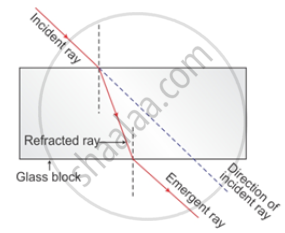
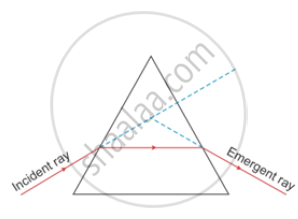
When a light ray passes through a prism, it bends towards the base of the prism. Hence, incident ray and emergent ray are not parallel to each other as they are in case of a glass slab.
APPEARS IN
RELATED QUESTIONS
Study the following four experimental set-ups I, II, III and IV for the experiment, "To trace the path of a ray of light through a rectangular glass slab."

Which of the marked set-ups is likely to give best results (P1 and P2 are the positions of pins fixed on the incident ray)?
(A) I
(B) II
(C) III
(D) IV
State the dependence of angle of deviation On the refractive index of the material of the prism.
A ray of light passes from water to air. How does the speed of light change?
When a lighted candle is held in front of a thick plane glass mirror, several images can be seen, but the second image is the brightest, give reason.
When light travels from a rarer to a denser medium, its speed ______.
With the help of diagram of the principal section of a prism, indicate its refracting surfaces, refracting edge and base.
Select from the following the best set-up for tracing the path of a ray of light through a rectangular glass slab:

(A) I
(B) II
(C) III
(D) IV
The diagram shows the path of a ray of light through a rectangular glass block placed in a liquid of uniform density.

Show with the help of a ray diagram the path of the ray when incident ray normally falls on the first surface of the glass block and passes through the block and the liquid.
Trace a ray of light incident at 30° on a surface if travelling from glass to air. What is the angle of refraction in this case? (R.I. for glass = 3/2).
Draw the ray diagram of a glass slab having medium A and B for the velocity of light ray VA and VB respectively and define Snell's law.
- If VB = 1.5 VA, then which medium is denser?
- What is the refractive index of A with respect to B?
- What is the refractive index of B with respect to A?
