Advertisements
Advertisements
प्रश्न
Light passes through a rectangular glass slab and through a triangular glass prism. In what way does the direction of the two emergent beams differ and why?
Advertisements
उत्तर
In case of a rectangular glass slab, emergent rays of light are always parallel to the direction of incident rays.
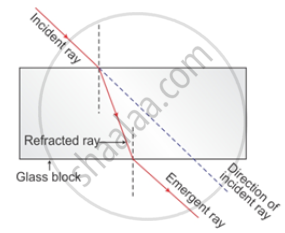
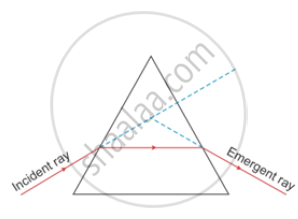
When a light ray passes through a prism, it bends towards the base of the prism. Hence, incident ray and emergent ray are not parallel to each other as they are in case of a glass slab.
APPEARS IN
संबंधित प्रश्न
When rays of light are incident on a glass slab then the incident ray and emergent ray are _________ each other.
- perpendicular
- parallel
- opposite
- concurrent
Choose the correct alternative and rewrite the following sentence.
A ray of light strikes the glass slab at an angle of 50°. What is the angle of incidence?
Why do we get a spectrum of seven colors when white light is dispersed by a prism?
A ray of light is passing from a transparent medium 1 to another transparent medium 2 (i) Speed up (ii) slows down. In each case, state whether the refractive index of medium 2 is equal to, less than or greater than the refractive index of medium 1.
A coin is places at the bottom of a beaker containing water (refractive index = 4/3) to a depth of 12 cm. By what height the coin appears to be raised when seen from vertically above?
A total reflecting right angled isosceles prism can be used to deviate a ray of light through:
(a) 30° (b) 60° (c) 75° (d) 90°.
Comment on the statement ‘The refractive index of glass is 3/2.’
Explain briefly what causes the twinkling of stars at night.
What is the total reflecting prism?
A coin placed at the bottom of a beaker appears to be raised by 4.0 cm. If the refractive index of water is 4/3, find the depth of the water in the beaker.
