Advertisements
Advertisements
प्रश्न
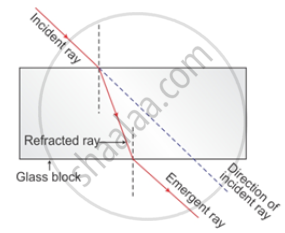
Light passes through a rectangular glass slab and through a triangular glass prism. In what way does the direction of the two emergent beams differ and why?
Advertisements
उत्तर
In case of a rectangular glass slab, emergent rays of light are always parallel to the direction of incident rays.
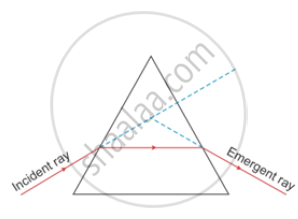
When a light ray passes through a prism, it bends towards the base of the prism. Hence, incident ray and emergent ray are not parallel to each other as they are in case of a glass slab.
APPEARS IN
संबंधित प्रश्न
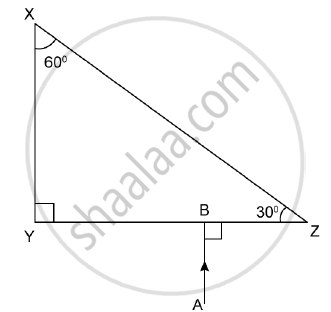
The following diagram shows a 60°, 30°, 90° glass prism of critical angle 42°, Copy the diagram and complete the path of incident ray AB emerging out of the prism marking the angle of incidence on each surface.
Trace the path of a ray of light incident at an angle of 45° on a rectangular glass slab. Write the measure of the angle of refraction, the angle of emergence and the lateral displacement suffered by the ray as it passes through the slab.
What is the correct reason for blinking / flickering of stars? Explain it.
a) The blasts in the stars.
b) Absorption of star light by the atmosphere.
c) Motion of the stars.
d) Changing refractive index of gases in the atmosphere.
How does the deviation produced by a prism depend on the refraction index of its material.
How does the angle of deviation produced by a prism depend on the colour of light used? Which colour of white light is deviated (i) most, (ii) least, by a prism?
Draw ray of light bending towards the normal while passing from air to glass. Label your diagrams.
The diagram shows the path of a ray of light through a rectangular glass block placed in a liquid of uniform density.

What is the angular, deviation of the emergent ray from the glass block with respect to the incident ray?
A ray of light PQ is incident normally on the hypotenuse of a right-angled prism ABC as shown in the diagram given below:

(i) Copy the diagram and complete the path of the ray PQ till it emerges from the prism.
(ii) What is the value of the angle of deviation of the ray?
(iii) Name an instrument where this action of the prism is used.
A coin placed at the bottom of a beaker appears to be raised by 4.0 cm. If the refractive index of water is 4/3, find the depth of the water in the beaker.
