Advertisements
Advertisements
प्रश्न
The diagram shows the path of a ray of light through a rectangular glass block placed in a liquid of uniform density.

What is the angular, deviation of the emergent ray from the glass block with respect to the incident ray?
Advertisements
उत्तर
As shown by the line in the diagram, the emergent ray is parallel to the incident ray (when produced) and so there is no angular deviation.
संबंधित प्रश्न
Draw the diagram of refraction of light in the glass slab
When light travels from a rarer to a denser medium, its speed ______.
How does the speed of light change when it passes from glass to water?
Complete Fig. 4.32 to show the path of the ray of single colour as it enters the prism and emerges out of it. Mark the angles wherever necessary.
Select from the following the best experimental set-up for tracing the path of a ray of light through a glass slab: (A) I
(A) I
(B) II
(C) III
(D) IV
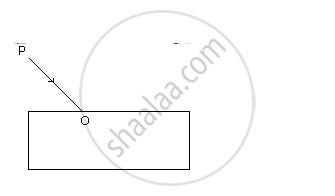
In the fig., PO is a ray of light incident on a rectangular glass block.
(a) Complete the path of the ray through the block.
(b) In the diagram, mark the angle of incidence (i) and the angle of refraction (r) at the first interface. How is the refractive index of glass related to the angles I and r?
(c) Mark angle of emergence by the letter e. How are the angles i and e related?
(d) Which two rays are parallel to each other? Name them.
(e) Indicate in the diagram the lateral displacement between the emergent ray and the incident ray.
Define the term refractive index of a medium in terms of velocity of light.
You are provided with a printed piece of paper. Using this paper how will you differentiate between a convex lens and a concave lens?
