Advertisements
Advertisements
प्रश्न
Advertisements
उत्तर
APPEARS IN
संबंधित प्रश्न
When light travels from a rarer to a denser medium, its speed ______.
Fill in the blanks to complete the following sentence
When light travels from a denser to a rarer medium, its speed ……………….
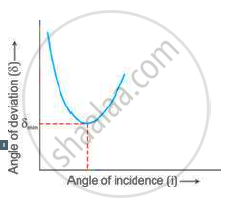
Using the curve, how do you infer that for given prism, the angle of minimum deviation δmin is unique for the given light?
Comment on the statement ‘The refractive index of glass is 3/2.’
Why does the sun appear bigger during sunset or sunrise?
In what condition a prism is said to be in the position of minimum deviation? What is the direction of the refracted ray inside the prism in this condition?
How does the angle of deviation produced by a prism depend on the angle of incidence of light at the prism surface? Draw a graph to illustrate your answer.
Observe the figure and name the ray AB, ray CD, ray GH.

