Advertisements
Advertisements
प्रश्न
A ray of light of wavelength 6600 Å suffer refraction from air to glass. Taking \[\ce{_a\mu_g = \frac{3}{2}}\], find the wavelength of light in glass.
Advertisements
उत्तर
We know that V = f λ
air μ glass = `"Velocity in vacuum or air"/"Velocity in glass"`
`3/2 = (f "air" xx λ "air")/(f "glass" xx λ "glass")`
However, light's frequency does not change as it refracts.
∴ f air = f glass
∴ `3/2 = (λ "air")/(λ "glass")`
λ glass = wave length in glass = `2/3 λ` air
λ glass = `2/3 xx 6600`
= 4400 Å
APPEARS IN
संबंधित प्रश्न
When a ray of light travels from air to glass slab and strikes the surface of separation at 90°, then it …………….
(a) bends towards normal
(b) bends away from normal
(c) passes unbent
(d) passes in zigzag way
Study the following four experimental set-ups I, II, III and IV for the experiment, "To trace the path of a ray of light through a rectangular glass slab."

Which of the marked set-ups is likely to give best results (P1 and P2 are the positions of pins fixed on the incident ray)?
(A) I
(B) II
(C) III
(D) IV
Fill in the blanks to complete the following sentence
The refractive index of glass with respect to air is 3/2. The refractive index of air with respect to glass will be ……………….
Complete Fig. 4.32 to show the path of the ray of single colour as it enters the prism and emerges out of it. Mark the angles wherever necessary.
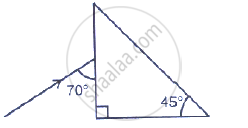
Four students showed the following traces of the path of a ray of light passing through a rectangular glass slab.

The trace most likely to be correct is that of student
(A) I
(B) II
(C) III
(D) IV
What is the correct reason for blinking / flickering of stars? Explain it.
a) The blasts in the stars.
b) Absorption of star light by the atmosphere.
c) Motion of the stars.
d) Changing refractive index of gases in the atmosphere.
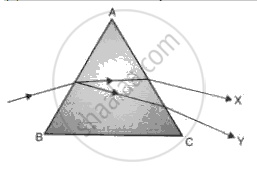
Fig. shows a ray of white light that passes through a prism and produces a spectrum.
(a) Name the phenomenon that is taking place.
(b) What colour would you see at X and Y?
(c) What radiation would you detect above X and below Y?
A total reflecting equilateral prism can be used to deviate a ray of light through:
Define the term refractive index of a medium in terms of velocity of light.
