Advertisements
Advertisements
प्रश्न
Advertisements
उत्तर
A prism itself produces no colour. This can be demonstrated by the following experiment.
Experiment: In figure below, white light from a slit s is made to pass through a prism P which forms the spectrum VR on a while screen AB. A narrow slit H is made on the screen AB parallel to the slit S to allow the light of a particular colour to pass through it. This light of a particular colour is made to fall on a seconf prism Q placed with its base in opposite directionj to that of the prism P. The light after passing through the second prism Q is recieved on another white screen M.
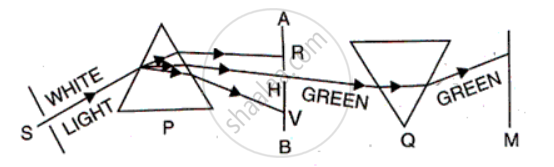
It is observed that the colour of light onbtained on the screen M is sames as that of the light incident on the second prism Q through the slit H. If green light is incident on the prism Q, the screen M has only green colour. This proves that the prism itself produces no coours.
APPEARS IN
संबंधित प्रश्न
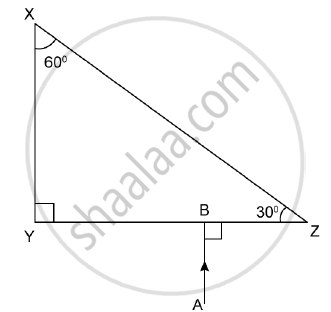
The following diagram shows a 60°, 30°, 90° glass prism of critical angle 42°, Copy the diagram and complete the path of incident ray AB emerging out of the prism marking the angle of incidence on each surface.
Write the relation between the angle of incidence and the angle of refraction for a medium.
Draw diagrams to show the refraction of light from
- air to glass, and
- glass to air. In each diagram, label the incident ray, refracted ray, the angle of incidence
- and the angle of refraction (r).
How does the angle of minimum deviation produces by a prism change with increase in :
the wavelength of incident light
A coin is places at the bottom of a beaker containing water (refractive index = 4/3) to a depth of 12 cm. By what height the coin appears to be raised when seen from vertically above?
(i) What is the relation between the refractive index of water with respect to air `("_aμ_\text(w))` and the refractive index of air with respect to water `("_\text(w)μ_ a)` .
(ii) If the refractive index of water with respect to air `("_aμ_\text(w))` is`5/3`. Calculate the refractive index of air with respect to water `("_\text(w)μ_ a)` .
How does the deviation produced by a prism depend on the wavelength of incident light?
Comment on the statement ‘The refractive index of glass is 3/2.’
