Advertisements
Advertisements
प्रश्न
Advertisements
उत्तर
A prism itself produces no colour. This can be demonstrated by the following experiment.
Experiment: In figure below, white light from a slit s is made to pass through a prism P which forms the spectrum VR on a while screen AB. A narrow slit H is made on the screen AB parallel to the slit S to allow the light of a particular colour to pass through it. This light of a particular colour is made to fall on a seconf prism Q placed with its base in opposite directionj to that of the prism P. The light after passing through the second prism Q is recieved on another white screen M.
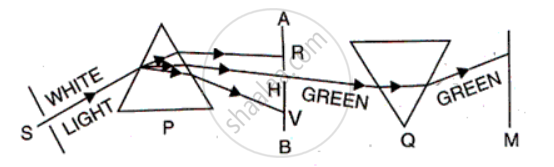
It is observed that the colour of light onbtained on the screen M is sames as that of the light incident on the second prism Q through the slit H. If green light is incident on the prism Q, the screen M has only green colour. This proves that the prism itself produces no coours.
APPEARS IN
संबंधित प्रश्न
Explain how spectrum is formed.
Draw a ray diagram to show the refraction of light through a glass slab and mark angle of refraction and the lateral shift suffered by the ray of light while passing through the slab.
A student very cautiously traces the path of a ray through a glass slab for different values of the angle of incidence (∠i). He then measures the corresponding values of the angle of refraction (∠r) and the angle of emergence (∠e) for every value of the angle of incidence. On analysing these measurements of angles, his conclusion would be
(A) ∠i > ∠r > ∠e
(B) ∠i = ∠e > ∠r
(C) ∠i < ∠r < ∠e
(D) ∠i = ∠e < ∠r
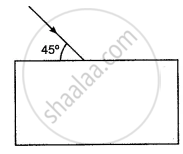
Draw the diagram given below and clearly show the path taken by the emergent ray.
What is the correct reason for blinking / flickering of stars? Explain it.
a) The blasts in the stars.
b) Absorption of star light by the atmosphere.
c) Motion of the stars.
d) Changing refractive index of gases in the atmosphere.
The critical angle for glass-air interface is :
The refractive index of air with respect to glass is defined: as gµa = sin i/sin r
Write down a similar expression for aµg in terms of angle i and r.
In the diagram below, PQ is a ray of light incident on a rectangular glass block.

How are the angles ‘i’ and ‘e’ related to each other?
Trace a ray of light incident at 30° on a surface if travelling from glass to air. What is the angle of refraction in this case? (R.I. for glass = 3/2).
