Advertisements
Advertisements
प्रश्न
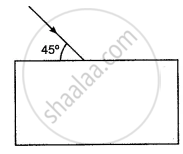
Draw the diagram given below and clearly show the path taken by the emergent ray.
Advertisements
उत्तर
ic = 42 for glass. The ray undergoes refraction as it emerges away from the slab.

APPEARS IN
संबंधित प्रश्न
Draw the diagram of refraction of light in the glass slab
How does the speed of light change when it passes from glass to water?
Define the term refractive index of a medium in terms of velocity of light.
How is the refractive index of a medium related to its real depth and apparent depth?
Express the refractive index μ of a medium in terms of the velocity of light.
The refractive index of air with respect to glass is defined: as gµa = sin i/sin r
If r = 90°, what is the corresponding angle i called?
In the diagram alongside a ray of light, PQ is incident normally on one face AB of an equilateral glass prism. What is the angle of incidence at the faces AB and AC?

Complete the ray diagram showing its emergence into the air after passing through the prism.

How will you verify the laws of refraction or how the refractive index of glass is determined in the laboratory?
The diagram shows the path of a ray of light through a rectangular glass block placed in a liquid of uniform density.

What is the angular, deviation of the emergent ray from the glass block with respect to the incident ray?
