Advertisements
Advertisements
प्रश्न
How does the angle of deviation produced by a prism depend on the angle of incidence of light at the prism surface? Draw a graph to illustrate your answer.
Advertisements
उत्तर
First, the angle of deviation produced by prism decreases with the increasing angle of incidence but on further increasing the angle of incidence the angle of deviation increases. The figure given inside shows the graph for variation of the angle of deviation with the angle of incidence.

संबंधित प्रश्न
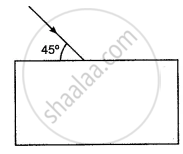
Draw the diagram given below and clearly show the path taken by the emergent ray.
Which of the following has the highest refractive index:
Light of a single colour is passed through a liquid having a piece of glass suspended in it. On changing the temperature of liquid, at a particular temperature, the glass piece is not seen.
Why is the light of a single colour used ?
Glass is transparent in nature. Why does glass powder look opaque? When water is poured over it, it again becomes transparent. Why?
Does the depth of a tank of water appear to change or remain the same when viewed normally from above?
How will you verify the laws of refraction or how the refractive index of glass is determined in the laboratory?
The diagram shows the path of a ray of light through a rectangular glass block placed in a liquid of uniform density.

Show with the help of a ray diagram the path of the ray when incident ray normally falls on the first surface of the glass block and passes through the block and the liquid.
Trace a ray of light incident at 30° on a surface if travelling from air to glass. What is the angle of refraction in this case? (R.I. for glass = 3/2).
Write the approximate values of speed of light in (i) air and (ii) glass. Use these values to calculate the refractive index of glass with respect to air.
The refractive index of glass with respect to air is 3/2. What is the refractive index of air with respect to glass?
