Advertisements
Advertisements
प्रश्न
A ray of light passes from water to air. How does the speed of light change?
Advertisements
उत्तर
The speed of light increases as it passes from water to air.
APPEARS IN
संबंधित प्रश्न
Define refraction and state the laws of refraction.
A pond appears to be 2.7 m deep. If the refractive index of water is `4/3`, find the actual depth of the pond.
Select from the following the best experimental set-up for tracing the path of a ray of light through a glass slab: (A) I
(A) I
(B) II
(C) III
(D) IV
While tracing the path of a ray of light passing through a rectangular glass slab a student tabulated his observations as given below:
|
S.NO. |
∠i |
∠r |
∠e |
|
I |
60° |
40° |
61° |
|
II |
50° |
36° |
51° |
|
III |
40° |
28° |
39° |
|
IV |
30° |
20° |
31° |
The correct observations is:
(A) I
(B) II
(C) III
(D) IV
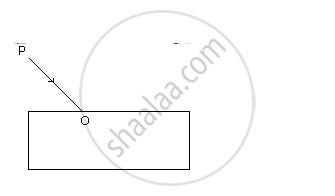
In the fig., PO is a ray of light incident on a rectangular glass block.
(a) Complete the path of the ray through the block.
(b) In the diagram, mark the angle of incidence (i) and the angle of refraction (r) at the first interface. How is the refractive index of glass related to the angles I and r?
(c) Mark angle of emergence by the letter e. How are the angles i and e related?
(d) Which two rays are parallel to each other? Name them.
(e) Indicate in the diagram the lateral displacement between the emergent ray and the incident ray.
Light of a single colour is passed through a liquid having a piece of glass suspended in it. On changing the temperature of liquid, at a particular temperature, the glass piece is not seen.
Why is the light of a single colour used ?
How does the deviation produced by a prism depend on the refraction index of its material.
Why upper surface of water contained in a beaker and above eye level appears silvery?
Why is the colour red used as a sign of danger?
Trace a ray of light incident at 30° on a surface if travelling from air to glass. What is the angle of refraction in this case? (R.I. for glass = 3/2).
