Advertisements
Advertisements
प्रश्न
A ray of light passes from water to air. How does the speed of light change?
Advertisements
उत्तर
The speed of light increases as it passes from water to air.
APPEARS IN
संबंधित प्रश्न
Write a short note on dispersion of light.
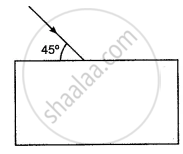
Draw the diagram given below and clearly show the path taken by the emergent ray.
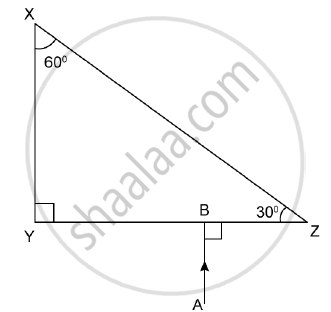
The following diagram shows a 60°, 30°, 90° glass prism of critical angle 42°, Copy the diagram and complete the path of incident ray AB emerging out of the prism marking the angle of incidence on each surface.
When light travels from a rarer to a denser medium, its speed ______.
A ray of light is passing from a transparent medium 1 to another transparent medium 2 (i) Speed up (ii) slows down. In each case, state whether the refractive index of medium 2 is equal to, less than or greater than the refractive index of medium 1.
How is the angle of emergence related to the angle of incidence when prism is in the position of minimum deviation? Illustrate your answer with help of a labelled diagram using an equilateral prism?
A student traces the path of a ray of white light through a rectangular glass slab and marks, the angles of incidence (∠i) , refraction (∠r) and emergence (∠e) as shown. Which angle or angles has he not marked correctly?

(A) ∠i only
(B) ∠i and ∠r
(C) ∠i and ∠e
(D) ∠r and ∠e
Glass is transparent in nature. Why does glass powder look opaque? When water is poured over it, it again becomes transparent. Why?
State the factors on which the angle of deviation depends.
