Advertisements
Advertisements
प्रश्न
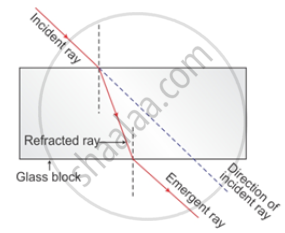
Light passes through a rectangular glass slab and through a triangular glass prism. In what way does the direction of the two emergent beams differ and why?
Light travels through a rectangular glass slab and through a triangular glass prism. How does the direction of the two emergent beams differ and why?
Advertisements
उत्तर
In case of a rectangular glass slab, emergent rays of light are always parallel to the direction of incident rays.
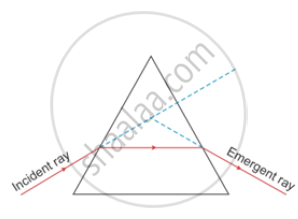
When a light ray passes through a prism, it bends towards the base of the prism. Hence, incident ray and the emergent ray are not parallel to each other, as they are in case of a glass slab.
संबंधित प्रश्न
State the dependence of angle of deviation on the wavelength of light
Which of the above wavelengths has a higher frequency?
A ray of light strikes the surface of a rectangular glass block such that the angle of incidence in
air is 0°.
In each case, draw diagram to show the path taken by the ray as it passes through the glass block and emerges from it.
Which of the following is the best experimental set-up out of the four shown for tracing the path of a ray of light passing through a rectangular glass slab ?
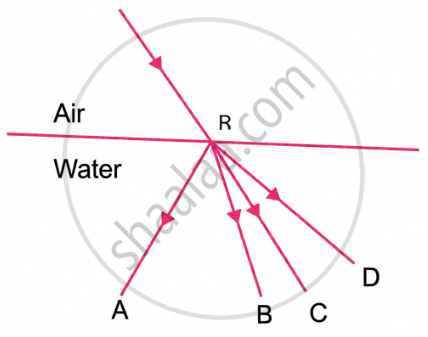
A ray of light passes from air to water. In fig., which of the ray A, B, C and D is the correct refracted ray?
Define the term refractive index of a medium in terms of velocity of light.
Draw ray of light bending towards the normal while passing from glass to water. Label your diagrams.
A coin placed at the bottom of a beaker appears to be raised by 4.0 cm. If the refractive index of water is 4/3, find the depth of the water in the beaker.
A ray of light strikes the surface of a rectangular glass slab such that the angle of incidence in air is
- 0°,
- 45°.
In each case, draw a diagram to show the path taken by the ray as it passes through the glass slab and emerges from it.
