Advertisements
Advertisements
Questions
Light passes through a rectangular glass slab and through a triangular glass prism. In what way does the direction of the two emergent beams differ and why?
Light travels through a rectangular glass slab and through a triangular glass prism. How does the direction of the two emergent beams differ and why?
Advertisements
Solution
In case of a rectangular glass slab, emergent rays of light are always parallel to the direction of incident rays.
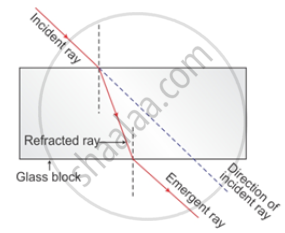
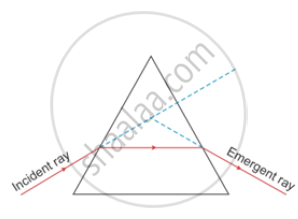
When a light ray passes through a prism, it bends towards the base of the prism. Hence, incident ray and the emergent ray are not parallel to each other, as they are in case of a glass slab.
RELATED QUESTIONS
Which colour of light travels fastest in any medium except air?
How must light travel out of a substance if it is not going to be refracted?
How is the angle of emergence related to the angle of incidence when prism is in the position of minimum deviation? Illustrate your answer with help of a labelled diagram using an equilateral prism?
A coin is places at the bottom of a beaker containing water (refractive index = 4/3) to a depth of 12 cm. By what height the coin appears to be raised when seen from vertically above?
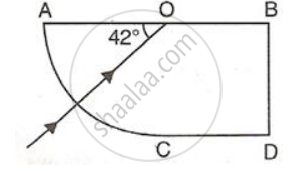
A ray of light enters a glass slab ABDC as shown in figure and strikes at the centre O of the circular part AC of the slab. The critical angle of glass is 42°. Complete the path of the ray till it emerges out from the slab. Mark the angles in the diagram wherever necessary.
A ray of light falls normally on the surface of a transparent glass slab. Draw a ray diagram to show its path and also mark angle of incidence and angle of emergence.
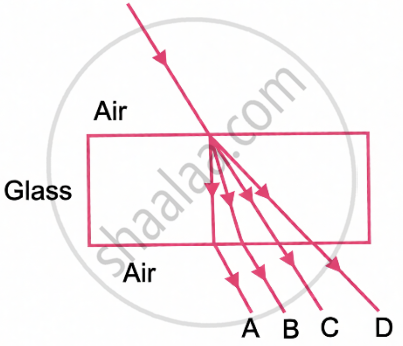
In the fig. name the ray which represents the correct path of light while passing through a glass block.
Which colour of light travels fastest in any medium except air?
Draw a diagram of a prism and label:
(i) the base,
(ii) the refracting surfaces,
(iii) the refracting edge,
(iv) the refracting angle in it.
Calculate the velocity of light in a glass block of refractive index 1.5. (Velocity of light in air = 3 × 10⁸ m/s)

