Advertisements
Advertisements
प्रश्न
Light passes through a rectangular glass slab and through a triangular glass prism. In what way does the direction of the two emergent beams differ and why?
Light travels through a rectangular glass slab and through a triangular glass prism. How does the direction of the two emergent beams differ and why?
Advertisements
उत्तर
In case of a rectangular glass slab, emergent rays of light are always parallel to the direction of incident rays.
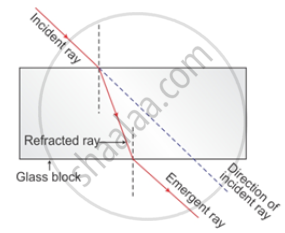
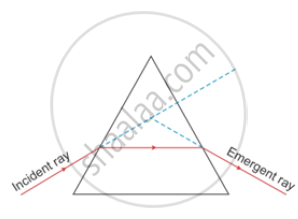
When a light ray passes through a prism, it bends towards the base of the prism. Hence, incident ray and the emergent ray are not parallel to each other, as they are in case of a glass slab.
संबंधित प्रश्न
Explain how the formation of a rainbow occurs.
Study the following four experimental set-ups I, II, III and IV for the experiment, "To trace the path of a ray of light through a rectangular glass slab."

Which of the marked set-ups is likely to give best results (P1 and P2 are the positions of pins fixed on the incident ray)?
(A) I
(B) II
(C) III
(D) IV
Which of the above wavelengths has a higher frequency?
Observe the following figure and answer the questions given under it:

1) How many times does refraction take place in the above figure?
2) What happens to the ray of light when it passes from air to glass?
3) What happens to the ray of light when it passes from glass to air?
4) What are the rays AB and CD in the figure called?
5) Define refraction.
Light of a single colour is passed through a liquid having a piece of glass suspended in it. On changing the temperature of liquid, at a particular temperature the glass piece is not seen. When is the glass piece not seen?
Which colour of light travels fastest in any medium except air?
How does the deviation produced by a prism depend on the refraction index of its material.
Why do the faces of persons sitting around campfire appear to shimmer?
How will you verify the laws of refraction or how the refractive index of glass is determined in the laboratory?
Calculate the velocity of light in a glass block of refractive index 1.5. (Velocity of light in air = 3 × 10⁸ m/s)

