Advertisements
Advertisements
प्रश्न
Why do the faces of persons sitting around campfire appear to shimmer?
Explain the following:
Why do the faces of people sitting around campfire appear to shimmer?
Advertisements
उत्तर
The rays coming from the face of the person, sitting across the campfire, suffer refraction on passing through hot air. Thus, we see the apparent image of the person. Since hot air is in motion, therefore its optical density changes, which in turn shifts the image rapidly. This rapidly shifting image gives a shimmering effect.
APPEARS IN
संबंधित प्रश्न
Choose the correct alternative and rewrite the following sentence.
A ray of light strikes the glass slab at an angle of 50°. What is the angle of incidence?
In your laboratory you trace the path of light rays through a glass slab for different values of angle of incidence (∠i) and in each case measure the values of the corresponding angle of refraction (∠r) and angle of emergence (∠e). On the basis of your observations your correct conclusion is:
(a) ∠i is more than ∠r, but nearly equal to ∠e
(b) ∠i is less then ∠r, but nearly equal to ∠e
(c) ∠i is more than ∠e, but nearly equal to ∠r
(d) ∠i is less than ∠e, but nearly equal to ∠r
When light travels from a rarer to a denser medium, its speed ______.
In fig 4.18, name the ray which represents the correct path of light while emerging out through a glass block.
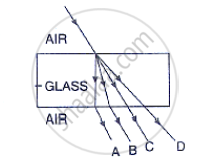
An object is viewed through a glass prism with its vertex pointing upwards. It appears to be displaced upward. Explain the reason.
How does the angle of deviation produced by a prism depend on the angle of incidence of light at the prism surface? Draw a graph to illustrate your answer.
Write the approximate values of speed of light in (i) air and (ii) glass. Use these values to calculate the refractive index of glass with respect to air.
A glass block is having refractive index 3/2, the light ray is incident at an angle 45°. Find the sine of the angle of, refraction inside the glass block.
