Advertisements
Advertisements
Question
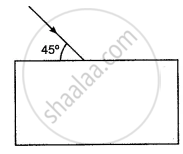
Draw the diagram given below and clearly show the path taken by the emergent ray.
Advertisements
Solution
ic = 42 for glass. The ray undergoes refraction as it emerges away from the slab.

RELATED QUESTIONS
Choose the correct alternative and rewrite the following sentence.
A ray of light strikes the glass slab at an angle of 50°. What is the angle of incidence?
Which of the above wavelengths has a higher frequency?
How does the angle of minimum deviation produces by a prism change with increase in :
the wavelength of incident light
How does the angle of minimum deviation produces by a prism change with increase in :
the refracting angle of prism?
Light of a single colour is passed through a liquid having a piece of glass suspended in it. On changing the temperature of liquid, at a particular temperature, the glass piece is not seen.
Why is the light of a single colour used ?
A ray of light strikes the surface at a rectangular glass slab such that the angle of incidence is 45o.
In each case, draw diagram to show the path taken by the ray as it passes through the glass slab and emerges from it.
Name the phenomenon responsible in the following case:
Apparent bending of a stick in water
Why do the faces of persons sitting around campfire appear to shimmer?
Name two instruments of the total refracting prism in which is used.
