English
Maharashtra State BoardSSC (English Medium) 10th Standard

Choose the Correct Alternative and Rewrite the Following Sentence. a Ray of Light Strikes the Glass Slab at an Angle of 50°. What is the Angle of Incidence? - Science and Technology 1

Advertisements
Advertisements

Question

Choose the correct alternative and rewrite the following sentence.

A ray of light strikes the glass slab at an angle of 50°. What is the angle of incidence?

Options

  • 50°

  • 90°

  • 60°

  • 40°

MCQ
Advertisements

Solution

40°

The ray of light strikes at an angle of 50 with the horizontal. The angle of incidence is with respect to the normal, so the angle of incidence is 90° − 50° = 40°.

shaalaa.com
  Is there an error in this question or solution?
2013-2014 (March)

RELATED QUESTIONS

Explain how the formation of a rainbow occurs.


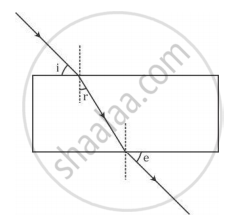
A student traces the path of a ray of light through a rectangular glass slab for the different values of angle of incidence. He observes all possible precautions at each step of the experiment. At the end of the experiment, on analyzing the measurements, which of the following conclusions is he likely to draw?

(A) ∠i = ∠e < ∠r

(B) ∠i < ∠e < ∠r

(C) ∠i > ∠e > ∠r

(D) ∠i = ∠e > ∠r


If the speed of light in vacuum is 3 × 10⁸ ms−1, find the speed of light in a medium of absolute refractive index 1.5.


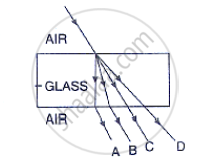
Study the following four experimental set-ups I, II, III and IV for the experiment, "To trace the path of a ray of light through a rectangular glass slab."

Which of the marked set-ups is likely to give best results (P1 and P2 are the positions of pins fixed on the incident ray)?

(A) I

(B) II

(C) III

(D) IV


On the basis of the experiment, "To trace the path of a ray of light through a rectangular glass slab", students of a class arrived at which one of the following conclusions?

(A) Angle of incidence is greater than the angle of emergence.

(B) Angle of emergence is smaller than the angle of refraction.

(C) Emergent ray is parallel to the refracted ray.

(D) Incident ray and emergent ray are parallel to each other.


Light passes through a rectangular glass slab and through a triangular glass prism. In what way does the direction of the two emergent beams differ and why?


A ray of light passes from glass into air. The angle of refraction will be:

(a) equal to the angle of incidence
(b) greater than the angle of incidence
(c) smaller than the angle of incidence
(d) 45° 


 How can you bend light away from the normal?


Light of a single colour is passed through a liquid having a piece of glass suspended in it. On changing the temperature of liquid, at a particular temperature the glass piece is not seen. When is the glass piece not seen?


When a lighted candle is held in front of a thick plane glass mirror, several images can be seen, but the second image is the brightest, give reason.


A ray of light is passing from a transparent medium 1 to another transparent medium 2 (i) Speed up (ii) slows down. In each case, state whether the refractive index of medium 2 is equal to, less than or greater than the refractive index of medium 1. 


The diagram alongside shows the refraction of a ray of light from air to a liquid.

  1. Write the values of (i) angle of incidence, (ii) angle of refraction.
  2. Use Snell’s law to find the refractive index of liquid with respect to air.


Fill in the blanks to complete the following sentence 

When light travels from a denser to a rarer medium, its speed ………………. 


While tracing the path of a ray of light passing through a rectangular glass slab a student tabulated his observations as given below:

S.NO.

∠i

∠r

∠e

I

60°

40°

61°

II

50°

36°

51°

III

40°

28°

39°

IV

30°

20°

31°

The correct observations is:

(A) I

(B) II

(C) III

(D) IV


A ray of light is incident normally on a plane glass slab. What will be
    1. the angle of refraction and
    2. the angle of deviation for the ray?

State the principle of reversibility of light.

Is dispersion same as deviation?

Name the factors on which the deviation produced by a prism depends.

Which of the following has the highest refractive index:


Can you guess the focal length of a plane mirror?

Fig shows a lens as a combination of a glass block and two prisms.

(i) Name the lens formed by the combination.

(ii) What is the line XX' called?

(iii) Complete the path of the incident ray PQ after passing through the lens.

(iv) The final emergent ray either meets XX' at a point or appears to come from a point on XX'. Label it as F, What is this point called?


 Draw a diagram to show the splitting of white light into its constituent colours.


Briefly, describe an experiment to show that a prism itself produces no colour.

Light of a single colour is passed through a liquid having a piece of glass suspended in it. On changing the temperature of liquid, at a particular temperature, the glass piece is not seen.

Why is the light of a single colour used ?


Glass is transparent in nature. Why does glass powder look opaque? When water is poured over it, it again becomes transparent. Why?


A ray of light passes from water to air. How does the speed of light change?


Why is the colour red used as a sign of danger?


How is the refractive index of a medium related to its real depth and apparent depth?


Express the refractive index μ of a medium in terms of the velocity of light.


The refractive index of air with respect to glass is defined: as gµa = sin i/sin r
Write down a similar expression for aµin terms of angle i and r.


A ray of monochromatic light is incident from air into a glass slab. Draw a labelled ray diagram indicating the change in its path till it emerges out of the slab. In the diagram, mark the angle of incidence (i) and the angle of refraction (r) at the first interface. How is the refractive index of glass related to the angles i and r?


After a robbery, if a window has been broken, there will be tiny particles of glass. Some of these will be found at the scene of the crime and some may be caught in the thief’s clothing. If the police can prove that these particles are identical, they have a strong case.
A method of doing this is to suspend the particles of glass in a special liquid. Light of a single colour is thrown through the liquid and the particles viewed through a microscope. The temperature of the liquid is then slowly altered. This alters the speed of light through the liquid (i.e., it alters the refractive index). At one particular temperature, the particles of glass disappear. It this happens at the same temperature for both sets of glass particles, they probably came from the same broken pane of glass.
Complete and copy the diagram to show how light bends when it travels from the liquid to the glass and back to the liquid, If the light slows down in the glass.


Draw a diagram to show the refraction of a monochromatic light ray through an equilateral prism. On the diagram, label the incident, refracted, and emergent rays. It also indicates the angle of deviation by the letter δ.


The diagram shows the path of a ray of light through a rectangular glass block placed in a liquid of uniform density.

What is the angular, deviation of the emergent ray from the glass block with respect to the incident ray?


The diagram shows the path of a ray of light through a rectangular glass block placed in a liquid of uniform density.

What should be the rate of the speed of light through the liquid to the speed through the glass so that there is no refraction of light at the boundaries of the glass block when the system is illuminated by the light of one colour?


The velocity of light in diamond is 121000 kms-1. What is its refractive index?


Draw the ray diagram of a glass slab having medium A and B for the velocity of light ray VA and VB respectively and define Snell's law.

  1. If VB = 1.5 VA, then which medium is denser?
  2. What is the refractive index of A with respect to B?
  3. What is the refractive index of B with respect to A?

A ray of light strikes the surface of a rectangular glass slab such that the angle of incidence in air is

  1. 0°,
  2. 45°.

In each case, draw a diagram to show the path taken by the ray as it passes through the glass slab and emerges from it.


Share
Notifications

Englishहिंदीमराठी


      Forgot password?
Use app×