Advertisements
Advertisements
Question
A ray of light of wavelength 6600 Å suffer refraction from air to glass. Taking \[\ce{_a\mu_g = \frac{3}{2}}\], find the wavelength of light in glass.
Advertisements
Solution
We know that V = f λ
air μ glass = `"Velocity in vacuum or air"/"Velocity in glass"`
`3/2 = (f "air" xx λ "air")/(f "glass" xx λ "glass")`
However, light's frequency does not change as it refracts.
∴ f air = f glass
∴ `3/2 = (λ "air")/(λ "glass")`
λ glass = wave length in glass = `2/3 λ` air
λ glass = `2/3 xx 6600`
= 4400 Å
APPEARS IN
RELATED QUESTIONS
What is a spectrum?
A student traces the path of a ray of light passing through a rectangular glass slab and marks the angle of incidence i, angle of refraction r and angle of emergence e, as shown.
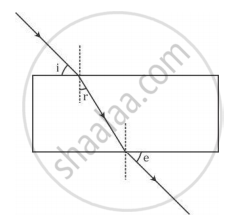
The correctly marked angle(s) is/are
(A) ∠ i only
(B) ∠ e only
(C) ∠ r only
(D) ∠ i and ∠ e
Explain the term absolute refractive index of a medium and write an expression to relate it with the speed of light in vacuum.
How can you bend light away from the normal?
Which of the following is the best experimental set-up out of the four shown for tracing the path of a ray of light passing through a rectangular glass slab ?
A ray of light falls normally on the surface of a transparent glass slab. Draw a ray diagram to show its path and also mark angle of incidence and angle of emergence.
In an experiment of finding the refractive index of glass, if blue light is replaced by the red light, how will the refractive index of glass change? Give reason in support of your answer.
Complete the ray diagram showing its emergence into the air after passing through the prism.

The diagram shows the path of a ray of light through a rectangular glass block placed in a liquid of uniform density.

(a) Does the light speed up or slow down in the glass,
(b) Give the reason for your answer.
