Advertisements
Advertisements
प्रश्न
Why do we get a spectrum of seven colors when white light is dispersed by a prism?
Advertisements
उत्तर
The refractive index of the material of the prism is different for different colours. White light is composed of seven colours. When white light is incident on a prism, the constituent colours get refracted through different angles and get dispersed. So, the rays of each colour emerge along different paths and become distinct. Hence, we get a spectrum of seven different colours.
APPEARS IN
संबंधित प्रश्न
After tracing the path of a ray of light passing through a rectangular glass slab for four different values of the angle of incidence, a student reported his observations in tabular form as given below:
| S.No | ∠ i | ∠ r | ∠ e |
| I | 30° | 19° | 29° |
| II | 40° | 28° | 40° |
| III | 50° | 36° | 50° |
| IV | 60° | 40° | 59° |
The best observation is
(A) I
(B) II
(C) III
(D) IV
Which of the above wavelengths has a higher frequency?
How can you bend light away from the normal?
When light travels from a rarer to a denser medium, its speed ______.
When a ray of light from air enters a denser medium, it ______.
How does the angle of minimum deviation produces by a prism change with increase in :
the wavelength of incident light
The diagram alongside shows the refraction of a ray of light from air to a liquid.
- Write the values of (i) angle of incidence, (ii) angle of refraction.
- Use Snell’s law to find the refractive index of liquid with respect to air.

The refractive index of glass is 1.5. From a point P inside a glass block, draw rays PA, PB and PC incident on the glass air surface at an angle of incidence 30°, 42° and 60° respectively.
- In the diagram show the approximate direction of these rays as they emerge out of the block.
- What is the angle of refraction for the ray PB?
`("Take" sin 42° =2/3)`
A ray of light falls normally on the surface of a transparent glass slab. Draw a ray diagram to show its path and also mark angle of incidence and angle of emergence.
While performing the experiment on tracing the path of a ray of light through a rectangular glass slab, in which of the following experimental set-ups is a student likely to get best results? P1 and P2 are the positions of pins fixed by him.
(A) I
(B) II
(C) III
(D) IV
Rahim recorded the following sets of observations while tracing the path of a ray of light passing through a rectangular glass slab for different angles of incidence.
|
S. No. |
Angle of incidence |
Angle of refraction |
Angle of emergence |
|
I |
45° |
41° |
45° |
|
II |
40° |
38° |
38° |
|
III |
45° |
41° |
40° |
|
IV |
41° |
45° |
41° |
The correct observation is recorded at serial number:
(1) I
(2) II
(3) III
(4) IV
What is the correct reason for blinking / flickering of stars? Explain it.
a) The blasts in the stars.
b) Absorption of star light by the atmosphere.
c) Motion of the stars.
d) Changing refractive index of gases in the atmosphere.
Which of the following has the highest refractive index:
Fig shows a lens as a combination of a glass block and two prisms.
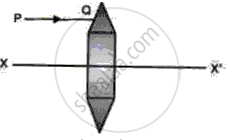
(i) Name the lens formed by the combination.
(ii) What is the line XX' called?
(iii) Complete the path of the incident ray PQ after passing through the lens.
(iv) The final emergent ray either meets XX' at a point or appears to come from a point on XX'. Label it as F, What is this point called?
Draw a diagram to show the splitting of white light into its constituent colours.
Name the phenomenon responsible in the following case:
Twinkling of stars
Why does a fisherman aim at the tail of fish during spearfishing?
A ray of light passes from water to air. How does the speed of light change?
State the factors on which the angle of deviation depends.
Express the refractive index μ of a medium in terms of the velocity of light.
What do you understand by the deviation produced by a prism?
A ray of monochromatic light is incident from the air on a glass slab:
(i) Draw a labelled ray diagram showing the change in the path of the ray till it emerges from the glass slab.
(ii) Name the two rays that are parallel to each other.
(iii) Mark the lateral displacement in your diagram.
How will you verify the laws of refraction or how the refractive index of glass is determined in the laboratory?
The diagram shows the path of a ray of light through a rectangular glass block placed in a liquid of uniform density.

(a) Does the light speed up or slow down in the glass,
(b) Give the reason for your answer.
The diagram shows the path of a ray of light through a rectangular glass block placed in a liquid of uniform density.

What should be the rate of the speed of light through the liquid to the speed through the glass so that there is no refraction of light at the boundaries of the glass block when the system is illuminated by the light of one colour?
Trace a ray of light incident at 30° on a surface if travelling from air to glass. What is the angle of refraction in this case? (R.I. for glass = 3/2).
Trace a ray of light incident at 30° on a surface if travelling from glass to air. What is the angle of refraction in this case? (R.I. for glass = 3/2).
Calculate the velocity of light in a glass block of refractive index 1.5. (Velocity of light in air = 3 × 10⁸ m/s)

A ray of light PQ is incident normally on the hypotenuse of a right-angled prism ABC as shown in the diagram given below:

(i) Copy the diagram and complete the path of the ray PQ till it emerges from the prism.
(ii) What is the value of the angle of deviation of the ray?
(iii) Name an instrument where this action of the prism is used.
The refractive index of glass with respect to air is 3/2. What is the refractive index of air with respect to glass?
Which colour of white light travels fastest in any medium except air?
