Advertisements
Advertisements
प्रश्न
Explain how the formation of a rainbow occurs.
Advertisements
उत्तर
(i) The formation of a rainbow in the sky is a combined result of refraction, dispersion and reflection of sunlight by water droplets present in the atmosphere after it has rained.

(ii) Sunlight is a mixture of seven colours: Violet, indigo, blue, green, yellow, orange and red. After it has stopped raining, the atmosphere contains a large number of water droplets. When sunlight is incident on a water droplet, there is
- Refraction and dispersion of light as it passes from air to water
- Internal reflection of light inside the droplet
- Refraction of light as it passes from water to air
(iii) The refractive index of water is different for different colours, being maximum for violet and minimum for red. Hence, there is dispersion of light (separation into different colours) as it passes from air to water.
(iv) The combined action of different water droplets (acting like tiny prisms) produces a rainbow with red colour on the outer side and violet colour on the inner side. The remaining five colours lie between these two colours. The rainbow is seen when the Sun is behind the observer and the water droplets are in the front.
APPEARS IN
संबंधित प्रश्न
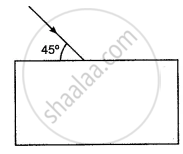
Draw the diagram given below and clearly show the path taken by the emergent ray.
Observe the following figure and answer the questions given under it:

1) How many times does refraction take place in the above figure?
2) What happens to the ray of light when it passes from air to glass?
3) What happens to the ray of light when it passes from glass to air?
4) What are the rays AB and CD in the figure called?
5) Define refraction.
How is the reflection of light ray from a plane mirror different from the refraction of light ray as it enters a block of glass?
For which colour of white light, is the refractive index of a transparent medium the most?
When a lighted candle is held in front of a thick plane glass mirror, several images can be seen, but the second image is the brightest, give reason.
With the help of diagram of the principal section of a prism, indicate its refracting surfaces, refracting edge and base.
How does the speed of light change when it passes from glass to water?
(i) What is the relation between the refractive index of water with respect to air `("_aμ_\text(w))` and the refractive index of air with respect to water `("_\text(w)μ_ a)` .
(ii) If the refractive index of water with respect to air `("_aμ_\text(w))` is`5/3`. Calculate the refractive index of air with respect to water `("_\text(w)μ_ a)` .
The critical angle for glass-air interface is :
Why upper surface of water contained in a beaker and above eye level appears silvery?
Name one main factor on which the direction of bending of a ray of light depends.
Why does the sun appear bigger during sunset or sunrise?
The refractive index of air with respect to glass is defined: as gµa = sin i/sin r
Write down a similar expression for aµg in terms of angle i and r.
Draw ray of light bending towards the normal while passing from air to glass. Label your diagrams.
Two parallel rays of Red and Violet travelling through the air, meet the air-glass boundary as shown in the above figure. Will their paths inside the glass be parallel? Give a reason for your answer.

A glass block is having refractive index 3/2, the light ray is incident at an angle 45°. Find the sine of the angle of, refraction inside the glass block.
A coin placed at the bottom of a beaker appears to be raised by 4.0 cm. If the refractive index of water is 4/3, find the depth of the water in the beaker.
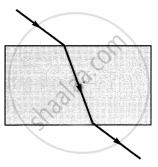
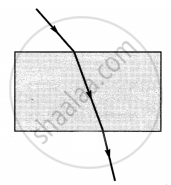
The path of a ray of light coming from air passing through a rectangular glass slab traced by four students are shown as A, B, C and D in the figure. Which one of them is correct?
 |
 |
 |
 |
| A | B | C | D |
