Advertisements
Advertisements
प्रश्न
The speed of light in air is 3 × 10⁸ ms-1. Calculate the speed of light in water. The refractive index of water is 4/3.
Advertisements
उत्तर
The refractive index of water `="Speed of light in air"/"Speed of light in water"`
∴ Speed of light in water `="Speed of light in air"/"Refractive index of water"`
= `(3xx10^8)/(4//3)`
= 2.25 × 10⁸ ms−1.
संबंधित प्रश्न
On the basis of the experiment, "To trace the path of a ray of light through a rectangular glass slab", students of a class arrived at which one of the following conclusions?
(A) Angle of incidence is greater than the angle of emergence.
(B) Angle of emergence is smaller than the angle of refraction.
(C) Emergent ray is parallel to the refracted ray.
(D) Incident ray and emergent ray are parallel to each other.
State the dependence of angle of deviation on the wavelength of light
Draw the diagram given below and clearly show the path taken by the emergent ray.
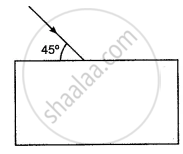
Name a prism required for obtaining a spectrum of Ultraviolet light.
How does the angle of minimum deviation produces by a prism change with increase in :
the refracting angle of prism?
While tracing the path of a ray of light passing through a rectangular glass slab a student tabulated his observations as given below:
|
S.NO. |
∠i |
∠r |
∠e |
|
I |
60° |
40° |
61° |
|
II |
50° |
36° |
51° |
|
III |
40° |
28° |
39° |
|
IV |
30° |
20° |
31° |
The correct observations is:
(A) I
(B) II
(C) III
(D) IV
Fill in the blank to complete the following sentence:
When light travels from a rarer to a denser medium, it bends ...........
Draw a diagram to show the splitting of white light into its constituent colours.
Why is the colour red used as a sign of danger?
Calculate the velocity of light in a glass block of refractive index 1.5. (Velocity of light in air = 3 × 10⁸ m/s)

