Advertisements
Advertisements
प्रश्न
What is meant by the statement the critical angle for diamond is 24°?
Advertisements
उत्तर
The critical angle for diamond is 24°. This implies that at an incident angle of 24° within the diamond the angle of refraction in the air will be 90°. And if incident angle will be more than this angle then the ray will suffer total internal reflection without any refraction.
संबंधित प्रश्न
Write the relation between the angle of incidence and the angle of refraction for a medium.
When light travels from a rarer to a denser medium, its speed ______.
The diagram alongside shows the refraction of a ray of light from air to a liquid.
- Write the values of (i) angle of incidence, (ii) angle of refraction.
- Use Snell’s law to find the refractive index of liquid with respect to air.

The critical angle for glass-air is 45° for the light of yellow colour. State whether it will be less than, equal to, or more than 45° for (i) ref light, (ii) blue light?
Why upper surface of water contained in a beaker and above eye level appears silvery?
You are provided with a printed piece of paper. Using this paper how will you differentiate between a convex lens and a concave lens?
The refractive index of glass with respect to air is 3/2. What is the refractive index of air with respect to glass?
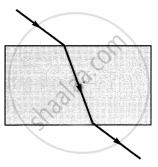
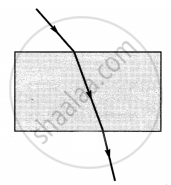
The path of a ray of light coming from air passing through a rectangular glass slab traced by four students are shown as A, B, C and D in the figure. Which one of them is correct?
 |
 |
 |
 |
| A | B | C | D |
A ray of light strikes the surface of a rectangular glass slab such that the angle of incidence in air is
- 0°,
- 45°.
In each case, draw a diagram to show the path taken by the ray as it passes through the glass slab and emerges from it.
