Advertisements
Advertisements
प्रश्न
Define the absolute refractive index.
Define absolute refractive index of an optical medium.
Advertisements
उत्तर
APPEARS IN
संबंधित प्रश्न
When rays of light are incident on a glass slab then the incident ray and emergent ray are _________ each other.
- perpendicular
- parallel
- opposite
- concurrent
A student traces the path of a ray of light passing through a rectangular glass slab and marks the angle of incidence i, angle of refraction r and angle of emergence e, as shown.
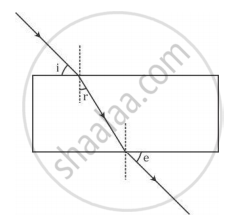
The correctly marked angle(s) is/are
(A) ∠ i only
(B) ∠ e only
(C) ∠ r only
(D) ∠ i and ∠ e
Draw a ray diagram to show the refraction of light through a glass slab and mark angle of refraction and the lateral shift suffered by the ray of light while passing through the slab.
Why is the ratio of the velocities of light of wavelengths 4000Å and 8000Å in vacuum 1: 1?
How must light travel out of a substance if it is not going to be refracted?
A ray of light of wavelength 6600 Å suffer refraction from air to glass. Taking \[\ce{_a\mu_g = \frac{3}{2}}\], find the wavelength of light in glass.
How is the angle of emergence related to the angle of incidence when prism is in the position of minimum deviation? Illustrate your answer with help of a labelled diagram using an equilateral prism?
A pond appears to be 2.7 m deep. If the refractive index of water is `4/3`, find the actual depth of the pond.
What is meant by the statement the critical angle for diamond is 24°?
A total reflecting right angled isosceles prism can be used to deviate a ray of light through:
(a) 30° (b) 60° (c) 75° (d) 90°.
Select from the following the best experimental set-up for tracing the path of a ray of light through a glass slab: (A) I
(A) I
(B) II
(C) III
(D) IV
Trace the path of a ray of light incident at an angle of 45° on a rectangular glass slab. Write the measure of the angle of refraction, the angle of emergence and the lateral displacement suffered by the ray as it passes through the slab.
Which colour of light travels fastest in any medium except air?
Why does a fisherman aim at the tail of fish during spearfishing?
Define the term refractive index of a medium in terms of velocity of light.
How does the angle of deviation produced by a prism depend on the angle of incidence of light at the prism surface? Draw a graph to illustrate your answer.
Trace a ray of light incident at 30° on a surface if travelling from air to glass. What is the angle of refraction in this case? (R.I. for glass = 3/2).
The refractive index of glass with respect to air is 3/2. What is the refractive index of air with respect to glass?
The path of a ray of light coming from air passing through a rectangular glass slab traced by four students are shown as A, B, C and D in the figure. Which one of them is correct?
 |
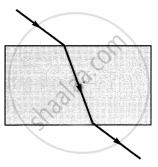 |
 |
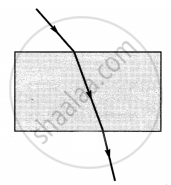 |
| A | B | C | D |
