मराठी
महाराष्ट्र राज्य शिक्षण मंडळएस.एस.सी (इंग्रजी माध्यम) इयत्ता १० वी

Observe the Figure and Write Accurate Conclusion Regarding Refraction of Light. - Science and Technology 1

Advertisements
Advertisements

प्रश्न

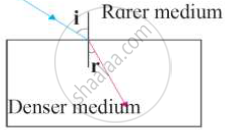
Observe the figure and write accurate conclusion regarding refraction of light.
Advertisements

उत्तर

When a light ray passes from a rarer medium to a denser medium, it bends towards the normal.

shaalaa.com
  या प्रश्नात किंवा उत्तरात काही त्रुटी आहे का?
2018-2019 (March) Balbharati Model Question Paper Set 1

संबंधित प्रश्‍न

Write a short note on dispersion of light.


Explain how the formation of a rainbow occurs.


A student traces the path of a ray of light through a rectangular glass slab for the different values of angle of incidence. He observes all possible precautions at each step of the experiment. At the end of the experiment, on analyzing the measurements, which of the following conclusions is he likely to draw?

(A) ∠i = ∠e < ∠r

(B) ∠i < ∠e < ∠r

(C) ∠i > ∠e > ∠r

(D) ∠i = ∠e > ∠r


After tracing the path of a ray of light passing through a rectangular glass slab for four different values of the angle of incidence, a student reported his observations in tabular form as given below:

S.No ∠ i ∠ r ∠ e
I 30° 19° 29°
II 40° 28° 40°
III 50° 36° 50°
IV 60° 40° 59°

The best observation is

(A) I

(B) II

(C) III

(D) IV


Study the following four experimental set-ups I, II, III and IV for the experiment, "To trace the path of a ray of light through a rectangular glass slab."

Which of the marked set-ups is likely to give best results (P1 and P2 are the positions of pins fixed on the incident ray)?

(A) I

(B) II

(C) III

(D) IV


Why do we get a spectrum of seven colors when white light is dispersed by a prism?


Explain the term absolute refractive index of a medium and write an expression to relate it with the speed of light in vacuum.


State the dependence of angle of deviation On the wavelength of light


The following diagram shows a 60°, 30°, 90° glass prism of critical angle 42°, Copy the diagram and complete the path of incident ray AB emerging out of the prism marking the angle of incidence on each surface.


Write the relation between the angle of incidence and the angle of refraction for a medium.


Draw diagrams to show the refraction of light from 

  1. air to glass, and
  2. glass to air. In each diagram, label the incident ray, refracted ray, the angle of incidence
  3. and the angle of refraction (r).

Light of a single colour is passed through a liquid having a piece of glass suspended in it. On changing the temperature of liquid, at a particular temperature the glass piece is not seen. When is the glass piece not seen?


With the help of diagram of the principal section of a prism, indicate its refracting surfaces, refracting edge and base. 


How does the angle of deviation produced by a prism change with increase in the angle of incidence. Draw a curve showing the variation in the angle of deviation with the angle of incidence at a prism surface.


In fig 4.18, name the ray which represents the correct path of light while emerging out through a glass block. 


A postage stamp kept below a rectangular glass block of refractive index 1.5 when viewed from vertically above it, appears to be raised by 7.0 mm. Calculate the thickness of the glass slab.


The critical angle for glass-air is 45° for the light of yellow colour. State whether it will be less than, equal to, or more than 45° for (i) ref light, (ii) blue light? 


The refractive index of air with respect to glass is expressed as `""_g μ_a=sin i /sin r`.

  1. Write down a similar expression for aμg in terms of the angles i and r.
  2. If angle r = 90°, what is the corresponding angle i called?
  3. What is the physical significance of the angle i in part (b)? 

The refractive index of glass is 1.5. From a point P inside a glass block, draw rays PA, PB and PC incident on the glass air surface at an angle of incidence 30°, 42° and 60° respectively.

  1. In the diagram show the approximate direction of these rays as they emerge out of the block.
  2. What is the angle of refraction for the ray PB? 

`("Take" sin 42° =2/3)` 


A ray of light OP passes through a right angles prism as shown in the adjacent diagram.
(a) State the angles of incidence at the faces AC and BC.
(b) Name the phenomenon which the ray suffers at the face AC. 


A student has traced the path of a ray of light through a glass slab as follows. If you are asked to label 1, 2, 3 and 4, the correct sequencing of labeling  ∠i, ∠e, ∠r and lateral displacement respectively is

(a) 2, 1, 3, 4

(b) 1, 2, 3, 4

(c) 1, 3, 2, 4

(d) 1, 3, 4, 2


After tracing the path of rays of light through a glass slab for three different angles of incidence, a student measured the corresponding values angle of refraction r and angle of emergence e and recorded them in the table given below: 

S. No.

i

i

e

I

30°

20°

31°

II

40°

25°

40°

III

50°

31°

49°

The correct observations are:

(A) I and II

(B) II and III

(C) I and III

(D) I, II and III


A ray of light falls normally on the surface of a transparent glass slab. Draw a ray diagram to show its path and also mark angle of incidence and angle of emergence.


For which colour of white light, is the refractive index of glass the most?

Define the absolute refractive index of a medium.

State two uses of a total reflecting prism as a reflector in place of a plane mirror.

Draw an í- `delta` graph for a mono chromatic raY through a glass prism of a plane and mark

(i) `delta` m, the angle of mínimum devíation

(íí) Any two values of i for which value of `delta` ís same.  


Fig shows a lens as a combination of a glass block and two prisms.

(i) Name the lens formed by the combination.

(ii) what is the XX' called?

(iii) Complete the ray diagram and show the path of the incident ray PQ after passing through the lens.

(iv) The final emergent ray will either meet XX' at a point or appear to come from a point on XX'. what is the point called?


State any two ways of increasing the frequency of vibration of a stretched string.

Fig. shows a ray of white light that passes through a prism and produces a spectrum.
(a) Name the phenomenon that is taking place.
(b) What colour would you see at X and Y?
(c) What radiation would you detect above X and below Y?


In an experiment of finding the refractive index of glass, if blue light is replaced by the red light, how will the refractive index of glass change? Give reason in support of your answer.


Light of a single colour is passed through a liquid having a piece of glass suspended in it. On changing the temperature of liquid, at a particular temperature, the glass piece is not seen.

Why is the light of a single colour used ?


The critical angle for glass-air interface is :


What is meant by the refraction of light?


State the relation between the refractive index μ and the velocity of light (vm) in that medium.


Why does the sun appear bigger during sunset or sunrise?


What do you understand by the deviation produced by a prism?


A ray of monochromatic light is incident from air into a glass slab. Draw a labelled ray diagram indicating the change in its path till it emerges out of the slab. In the diagram, mark the angle of incidence (i) and the angle of refraction (r) at the first interface. How is the refractive index of glass related to the angles i and r?


How will you verify the laws of refraction or how the refractive index of glass is determined in the laboratory?


Trace a ray of light incident at 30° on a surface if travelling from glass to air. What is the angle of refraction in this case? (R.I. for glass = 3/2).


Share
Notifications

Englishहिंदीमराठी


      Forgot password?
Use app×