Advertisements
Advertisements
प्रश्न
Fig shows a lens as a combination of a glass block and two prisms.
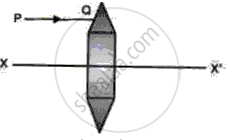
(i) Name the lens formed by the combination.
(ii) what is the XX' called?
(iii) Complete the ray diagram and show the path of the incident ray PQ after passing through the lens.
(iv) The final emergent ray will either meet XX' at a point or appear to come from a point on XX'. what is the point called?
Advertisements
उत्तर
(i) Convex lens
(ii) The line XX' is calledf the principal axis.
(iii)
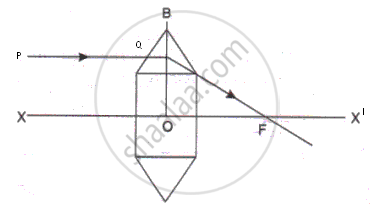
(iv) The final emergent ray will meet XX' at a point called its principal focus of the lens.
APPEARS IN
संबंधित प्रश्न
Study the following four experimental set-ups I, II, III and IV for the experiment, "To trace the path of a ray of light through a rectangular glass slab."

Which of the marked set-ups is likely to give best results (P1 and P2 are the positions of pins fixed on the incident ray)?
(A) I
(B) II
(C) III
(D) IV
Draw the diagram of refraction of light in the glass slab
Write the relation between the angle of incidence and the angle of refraction for a medium.
How does the angle of deviation produced by a prism change with increase in the angle of incidence. Draw a curve showing the variation in the angle of deviation with the angle of incidence at a prism surface.
A ray of light is passing from a transparent medium 1 to another transparent medium 2 (i) Speed up (ii) slows down. In each case, state whether the refractive index of medium 2 is equal to, less than or greater than the refractive index of medium 1.
A ray of light falls normally on the surface of a transparent glass slab. Draw a ray diagram to show its path and also mark angle of incidence and angle of emergence.
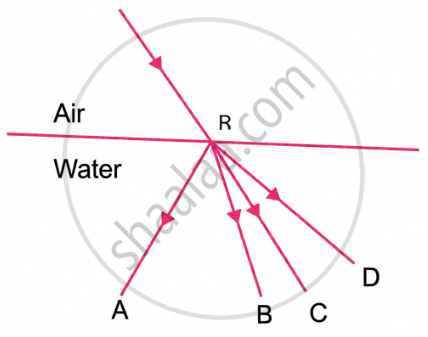
A ray of light passes from air to water. In fig., which of the ray A, B, C and D is the correct refracted ray?
Fill in the blank to complete the following sentence:
When light travels from a rarer to a denser medium, it bends ...........
Why is the colour red used as a sign of danger?
