Advertisements
Advertisements
प्रश्न
Fig shows a lens as a combination of a glass block and two prisms.
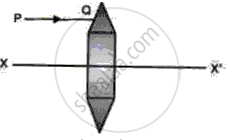
(i) Name the lens formed by the combination.
(ii) what is the XX' called?
(iii) Complete the ray diagram and show the path of the incident ray PQ after passing through the lens.
(iv) The final emergent ray will either meet XX' at a point or appear to come from a point on XX'. what is the point called?
Advertisements
उत्तर
(i) Convex lens
(ii) The line XX' is calledf the principal axis.
(iii)
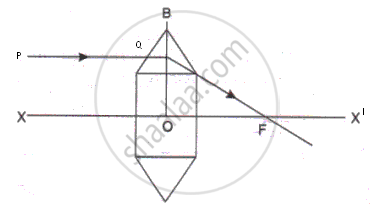
(iv) The final emergent ray will meet XX' at a point called its principal focus of the lens.
APPEARS IN
संबंधित प्रश्न
A student traces the path of a ray of light through a rectangular glass slab for the different values of angle of incidence. He observes all possible precautions at each step of the experiment. At the end of the experiment, on analyzing the measurements, which of the following conclusions is he likely to draw?
(A) ∠i = ∠e < ∠r
(B) ∠i < ∠e < ∠r
(C) ∠i > ∠e > ∠r
(D) ∠i = ∠e > ∠r
In your laboratory you trace the path of light rays through a glass slab for different values of angle of incidence (∠i) and in each case measure the values of the corresponding angle of refraction (∠r) and angle of emergence (∠e). On the basis of your observations your correct conclusion is:
(a) ∠i is more than ∠r, but nearly equal to ∠e
(b) ∠i is less then ∠r, but nearly equal to ∠e
(c) ∠i is more than ∠e, but nearly equal to ∠r
(d) ∠i is less than ∠e, but nearly equal to ∠r
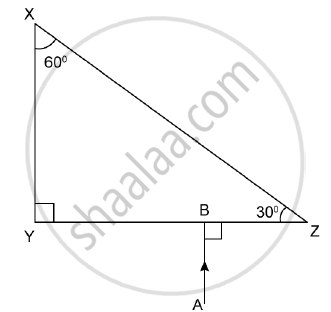
The following diagram shows a 60°, 30°, 90° glass prism of critical angle 42°, Copy the diagram and complete the path of incident ray AB emerging out of the prism marking the angle of incidence on each surface.
“A ray of light incident on a rectangular glass slab immersed in any medium emerges parallel to itself.” Draw labelled ray diagram to justify the statement.
Fig shows a lens as a combination of a glass block and two prisms.
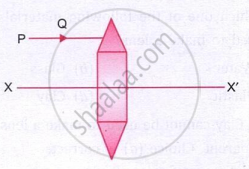
- Name the lens formed by the combination.
- What is the line XX' called?
- Complete the path of the incident ray PQ after passing through the lens.
- The final emergent ray either meets XX' at a point or appears to come from a point on XX'. Label it as F, What is this point called?
State the relation between the refractive index μ and the velocity of light (vm) in that medium.
What is the total reflecting prism?
In the diagram below, PQ is a ray of light incident on a rectangular glass block.

Copy the diagram and complete the path of the ray of light through the glass block. In your diagram, mark the angle of incidence by letter ‘i’ and the angle of emergence by the letter ‘e’.
How does the angle of deviation produced by a prism depend on the angle of incidence of light at the prism surface? Draw a graph to illustrate your answer.
Calculate the velocity of light in a glass block of refractive index 1.5. (Velocity of light in air = 3 × 10⁸ m/s)

