Advertisements
Advertisements
प्रश्न
State the condition of the following:
A ray passes undeviated through the lens.
Advertisements
उत्तर
A ray of light passing through the optical centre of the lens passes undeviated.
संबंधित प्रश्न
What is a lens?
State the condition when a lens is called an equi-convex or equi-concave.
In figure, (a) and (b), F1 and F2 are the two foci of thin lenses and AB is the incident ray. Complete the diagram to show the path of the ray AB after refraction through each lens.
 |
| (a) |
 |
| (b) |
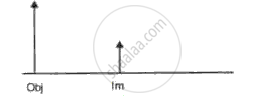
In the following diagram the object and the image formed by the respective lenses are shown. Complete the ray diagram, and locate the focus. Find the focal length of the lens.
A lens used as a magnifying glass
- is a diverging lens
- produces a virtual image
- is placed with the object nearer the lens than the principal focus
State the nature and position of the object on the principal axis to obtain a real and magnified image.
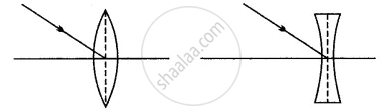
Complete the following diagram and state what happens to the ray of light after refraction through the lens.
In the following diagram, L1 and L2 are the two convex lense placed at separation equal to the sum of focal lengths of the two lenses. A and B are the two rays of light incident on the lens L1. Complete the path of rays till they emerge out of the lens L2.
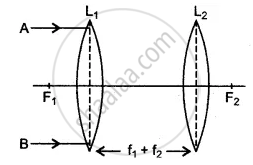
What principles have you used in completing the diagram?
Mixture of red + blue + green is passed through a convex lens as shown in the diagram below. State whether the ray passes through a single point or through different points on the principal axis after refraction.

