Advertisements
Advertisements
प्रश्न
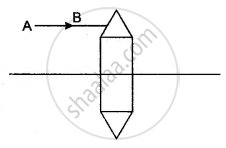
Mixture of red + blue + green is passed through a convex lens as shown in the diagram below. State whether the ray passes through a single point or through different points on the principal axis after refraction.

Advertisements
उत्तर
The ray will pass through different points on the principal axis after refraction through the convex lens. Red colour will deviate the least, followed by green, and then blue will deviate the most.
APPEARS IN
संबंधित प्रश्न
What is a lens?
The diagram given below shows the position of an object OA in relation to a converging lens whose foci are at F1 and F2.
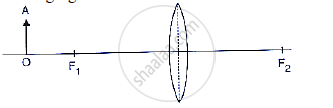
Describe how the distance of the image from the lens and the size of the image change as the object is moved towards F1.
For an object placed at a distance 20 cm in front of a convex lens, the image is at a distance 20 cm behind the lens. The focal length of the convex lens is ______.
(a) Draw a sketch to show how a lens is able to produce an image of the sun on a paper screen.
(b)(i) Would you regard the rays from the sun as being divergent, parallel or convergent?
(ii) What is the name given to the point where such rays meet after they have passed through the lens?
(iii) How does the image of the sun sometimes burn a paper screen?
In the following diagram , the object and the image formed by the respective lenses are shown. Complete the ray diagram, and locate the focus. Find the focal length of the lens.
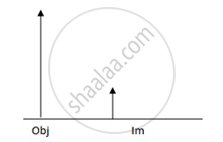
In the following diagram , the object and the image formed by the respective lenses are shown. Complete the ray diagram, and locate the focus. Find the focal length of the lens.
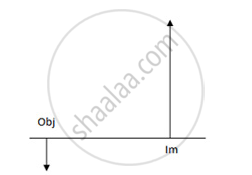
Fig. shows two rays of light Op and OQ coming from an object at the bottom of a pond, incident on the water surface.
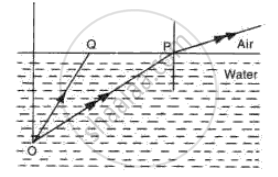
(a) Mark on the diagram
(i) The angle of incidence of ray OP,
(ii) The angle of refraction of ray Op,
(iii) The position of image of the object as seen from above.
(iv) An approximate path of the ray OQ.
(b) Explain, why do the rays of light change directions on passing from water to air.
(c) A fish in water sees everything outside the water by rays of light entering its eye in a small cone of light. Draw a diagram and explain how does this happen.
Name the subjective property of light related to its wavelength.
When does a ray of light falling on a lens pass through it undeviated?
The diagram showed a lens as a combination of one glass block and two prisms. Complete the ray diagram and show the part of the incident ray AB after passing through the lens.
(i) Name of the lens formed by the combination.
(ii) What is the line XX’ called?
(iii) Mark the focus F.