Advertisements
Advertisements
प्रश्न
A ray of light incident parallel to the principal axis of a lens, passes undeviated after refraction.
विकल्प
True
False
Advertisements
उत्तर
This statement is false.
APPEARS IN
संबंधित प्रश्न
What is a lens?
The diagram given below shows the position of an object OA in relation to a converging lens L whose foci are at F1 and F2.

- Draw two rays to locate the position of the image.
- State the position of the image with reference to the lens.
- Describe three characteristics of the image.
- Describe how the distance of the image from the lens and its size change as the object is moved towards F1.
Fig shows an object PQ placed on the principle axis of a lens L. The two foci of the kens are F1 and f2. The image formed by the lens is erect, Virtual and dimnished.
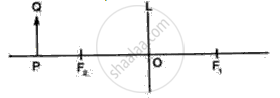
(i) Draw the outline ofthe lens L used and Named it.
(ii) Draw a ray of light starting from Q and passing through O. show the same ray after refraction by the lens.
(iii) Draw another ray from Q Which is incident parallel to the principle axis and show how it emerges after refraction from the lens.
(iv) Locate the final image formed.
(a) Draw a sketch to show how a lens is able to produce an image of the sun on a paper screen.
(b)(i) Would you regard the rays from the sun as being divergent, parallel or convergent?
(ii) What is the name given to the point where such rays meet after they have passed through the lens?
(iii) How does the image of the sun sometimes burn a paper screen?
A lens used as a magnifying glass
- is a diverging lens
- produces a virtual image
- is placed with the object nearer the lens than the principal focus
How will you differentiate between a convex and a concave lens by looking at a distant object.
How will you differentiate between a convex and a concave lens by looking at a printed page?
Mixture of red + blue + green is passed through a convex lens as shown in the diagram below. State whether the ray passes through a single point or through different points on the principal axis after refraction.

