Advertisements
Advertisements
प्रश्न
How will you differentiate between a convex and a concave lens by looking at a printed page?
Advertisements
उत्तर
On keeping the lens near a printed page, if the letters appear magnified, then the lens is convex, and if the letters appear diminished, then the lens is concave.
संबंधित प्रश्न
What is a lens?
Study the diagram shown in the following Figure.
Name the lens LL’ and draw its outline.
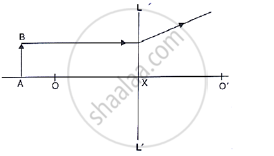
The diagram given below shows the position of an object OA in relation to a converging lens L whose foci are at F1 and F2.

- Draw two rays to locate the position of the image.
- State the position of the image with reference to the lens.
- Describe three characteristics of the image.
- Describe how the distance of the image from the lens and its size change as the object is moved towards F1.
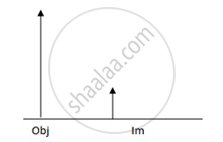
In the following diagram , the object and the image formed by the respective lenses are shown. Complete the ray diagram, and locate the focus. Find the focal length of the lens.
Make the correct choices in the following items:
lf the image can be focused on a screen it must be
Make the correct choices in the following items :
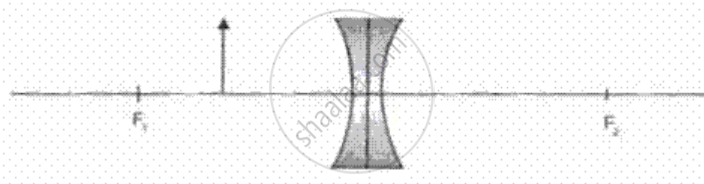
The image formed by a diverging lens, shown in fig, , is
A lens forms the image of an object placed at a distance of 45 cm from it on a screen placed at a distance 90 cm on the other side of it. Name the kind of lens.
State the nature and position of the object on the principal axis to obtain a real and magnified image.
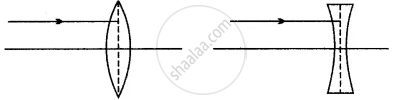
Complete the following diagram and state what happens to the ray of light after refraction through the lens.
Mixture of red + blue + green is passed through a convex lens as shown in the diagram below. State whether the ray passes through a single point or through different points on the principal axis after refraction.

