Advertisements
Advertisements
प्रश्न
Explain optical centre of a lens with the help of proper diagram(s).
Advertisements
उत्तर
Optical centre: "It is the point in the lens on the principal axis such that a ray of light passing through this point emerges parallel to the direction of incidence (or goes undeviated)."

APPEARS IN
संबंधित प्रश्न
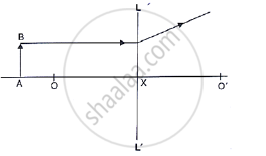
Study the diagram shown in Fig. 5.56
Where is the image formed?
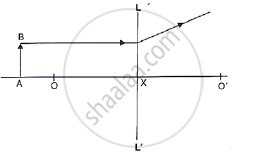
Study the diagram shown in Fig. 5.56
what are the two other characteristics of the image?
The diagram given below shows the position of an object OA in relation to a converging lens whose foci are at F1 and F2.
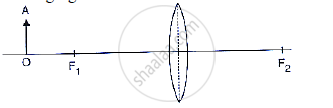
Describe three characteristic of the image.
State the condition of the following:
A lens has both its focal lengths equal.
(a) Draw a sketch to show how a lens is able to produce an image of the sun on a paper screen.
(b)(i) Would you regard the rays from the sun as being divergent, parallel or convergent?
(ii) What is the name given to the point where such rays meet after they have passed through the lens?
(iii) How does the image of the sun sometimes burn a paper screen?
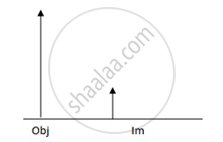
In the following diagram , the object and the image formed by the respective lenses are shown. Complete the ray diagram, and locate the focus. Find the focal length of the lens.
Make the correct choices in the following items:
lf the image can be focused on a screen it must be
(a)A ray of light is incident at 45° on the face of
(i) A rectangular block of glass.
(ii) A 600 glass prism.
(b) Draw a sketch showing how the ray of monochromatic ray of light passes through glass in each case.
(c) With the aid of a diagram, explain how the face of a right angled prism may totally reflect incident on it.
(d) A thick plane mirror produces several faint images in addition to a prominent one. Draw a ray diagram showing how reflection and refraction produce all these images.
(e) Fig. represents a stone S at the bottom of a pond of water. Using the two rays, as shown, complete the ray diagram to show where the image of the stone appears when viewed from E.
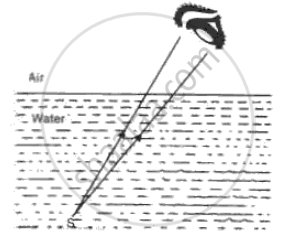
(f) What is a''mirage'? Explain with the help of a diagram.
(g) A man observes the bottom of a swimming pool of 3 m depth. If the refractive index of water is 1.3, what is the apparent depth of water?
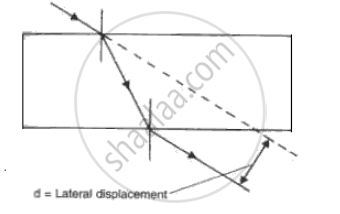
(h) When a ray of light undergoes refraction through a glass slab and when it emerges it is displaced laterally (Fig). What are the factors on which the lateral displacement depends?
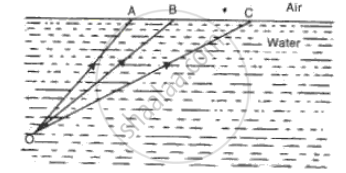
(i) Fig. shows three rays of light OA, OB and OC passing from water to air, making angles 490, 410 and 350 with the horizontal surface respectively. Draw an approximate path of the emergent ray for each. (Critical angle of water is 490.)
Name the subjective property of light related to its wavelength.
When does a ray of light falling on a lens pass through it undeviated?
