Advertisements
Advertisements
प्रश्न
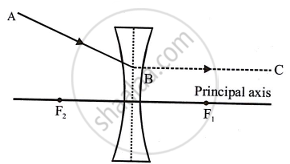
In figure, (a) and (b), F1 and F2 are the two foci of thin lenses and AB is the incident ray. Complete the diagram to show the path of the ray AB after refraction through each lens.
 |
| (a) |
 |
| (b) |
Advertisements
उत्तर
(a) Ray AB after refraction through convex lens takes the path as BC (parallel to the principal axis).

(b) Ray AB emerges parallel to the principal axis as BC after refraction.
APPEARS IN
संबंधित प्रश्न
In the following figure (a) and (b), F1 and F2 are positions of the two foci of thin lenses. Draw the path taken by the light ray AB after it emerges from each lens.
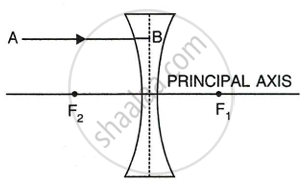 |
| (a) |
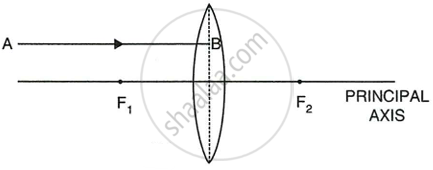 |
| (b) |
The diagram given below shows the position of an object OA in relation to a converging lens whose foci are at F1 and F2.
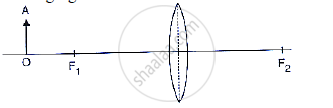
Describe three characteristic of the image.
For an object placed at a distance 20 cm in front of a convex lens, the image is at a distance 20 cm behind the lens. The focal length of the convex lens is ______.
State the condition of the following:
A lens has both its focal lengths equal.
State the condition of the following:
A ray passes undeviated through the lens.
Fig shows an object PQ placed on the principle axis of a lens L. The two foci of the kens are F1 and f2. The image formed by the lens is erect, Virtual and dimnished.
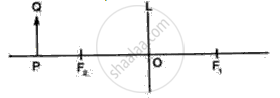
(i) Draw the outline ofthe lens L used and Named it.
(ii) Draw a ray of light starting from Q and passing through O. show the same ray after refraction by the lens.
(iii) Draw another ray from Q Which is incident parallel to the principle axis and show how it emerges after refraction from the lens.
(iv) Locate the final image formed.
Make the correct choices in the following items:
lf the image can be focused on a screen it must be
A lens forms the image of an object placed at a distance of 45 cm from it on a screen placed at a distance 90 cm on the other side of it. Name the kind of lens.
Name the subjective property of light related to its wavelength.
State the nature and position of the object on the principal axis to obtain a real and magnified image.
