Advertisements
Advertisements
प्रश्न
State the condition of the following:
A lens has both its focal lengths equal.
Advertisements
उत्तर
If the medium on both sides of the lens is same, the first and second focal lengths are equal.
संबंधित प्रश्न
The diagram below shows a lens as a combination of a glass slab and two prisms.
- Name the lens formed by the combination.
- What is the line XX’ called?
- Complete the path of the incident ray AB after passing through the lens.
- The final emergent ray either meets XX’ at a point or appears to come from a point on XX’. Label it as F. What is this point called?
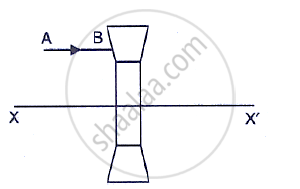
A ray of light incident on a lens parallel to its principal axis, after refraction passes through or appears to come from ______.
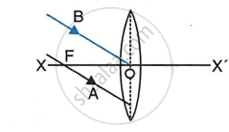
In the diagram below, XX’ represents the principal axis, O the optical centre and F the focus of the lens. Complete the path of rays A and B as they emerge out of the lens.
 |
 |
| (a) | (b) |
Distinguish between a real and a virtual image.
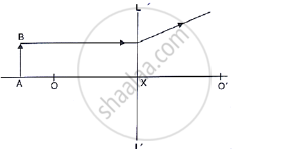
Study the diagram shown in Fig. 5.56
Complete the diagram to show the formation of image A’B’ of the object AB of same size.
State the condition of the following:
A ray passes undeviated through the lens.
In the following diagram ., the object and the image formed by the respective lenses are shown. Complete the ray diagram, and locate the focus. Find the focal length of the lens.
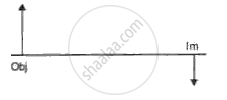
Fig. shows two rays of light Op and OQ coming from an object at the bottom of a pond, incident on the water surface.
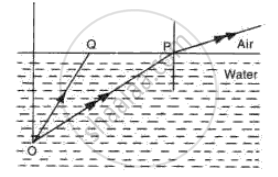
(a) Mark on the diagram
(i) The angle of incidence of ray OP,
(ii) The angle of refraction of ray Op,
(iii) The position of image of the object as seen from above.
(iv) An approximate path of the ray OQ.
(b) Explain, why do the rays of light change directions on passing from water to air.
(c) A fish in water sees everything outside the water by rays of light entering its eye in a small cone of light. Draw a diagram and explain how does this happen.
Complete the following diagram and state what happens to the ray of light after refraction through the lens.