Advertisements
Advertisements
प्रश्न
State two differences between normal reflection and total internal reflection.
Advertisements
उत्तर
| Reflection | Total Internal Reflection |
| Takes place in any medium, denser or rarer. | Takes place only in a denser medium. |
| Takes place for any angle of incidence. | Takes place only when the angle of incidence is greater than critical angle. |
APPEARS IN
संबंधित प्रश्न
The diagram below shows a point source P inside a water container. Four rays A, B, C, D starting from the source P, are shown up to the water surface.
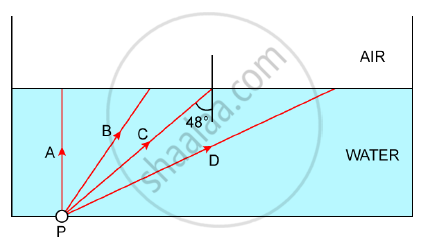
- Show in the diagram the path of these rays after striking the water surface. The Critical Angle for the water-air surface is 48°.
- Name the phenomenon which the rays B and D exhibit.
Name two factors which affect the critical angle for a given pair of media. State how do the factors affect it.
What is total internal reflection?
Two isosceles right-angle glass prisms P and Q are placed near each other as shown in Fig. Complete the path of the light ray entering the prism P till it emerges out of the prism Q.
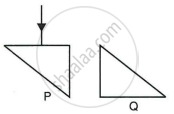
Name the factors affecting the critical angle for the pair of media.
Draw a diagram, properly labelled, to illustrate the use of a total reflecting prism (a right-angled isosceles prism) to turn a ray of light through 180°. Name an instrument in which this device is used.
Choose the correct option.
Select the WRONG statement.
For the same angle of incidence, the angle of refraction in four media A, B, C and D are 25°, 30°, 35° and 40° respectively. The speed of light is least in medium ______.
A given ray of light suffers minimum deviation in an equilateral prism P. Additional prism Q and R of identical shape and of the same material as P are now added as shown in the figure. The ray will now suffer ______.
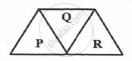
Find the value of θ in the given figure.