Advertisements
Advertisements
प्रश्न
Solve the previous problem if the paperweight is inverted at its place so that the spherical surface touches the paper.
Advertisements
उत्तर
Given,
Taking the radius of the paperweight as its thickness = 3 cm
Refractive index of the paperweight (μg) = 3/2
Refractive index of the air (μ1) = 1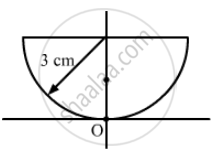
Image shift is given by:
\[∆ t = \left( 1 - \frac{1}{\mu} \right)t\]
\[ = \left( 1 - \frac{2}{3} \right)3\]
\[ = \left( \frac{1}{3} \right)3\]
\[ = 1 \text{ cm }\]
The upper surface of the paperweight is flat and the spherical spherical surface is in contact with the printed letter.
Therefore, we will take it as a simple refraction problem.
Hence, the image will appear 1 cm above point A.
APPEARS IN
संबंधित प्रश्न
State the relation between the critical angle and the absolute refractive index of a medium.
Plot a graph between
Sine of angle of incidence versus sine of angle of refraction,
If a light ray does not undergo, refraction at the boundary between two media, the angle of incidence is:
Name the principle on the basis of which optical fibres work.
If a ray of light passes from medium I to medium II without any change of direction, what can be said about the refractive indices of these media (angle I is not 0)?
How are critical angles related to the refractive index of the medium?
State two advantages of using a right-angle prism as a reflector, rather than a plane mirror.
State one factor on which a critical angle for a given pair of media depends. The critical angle for the glass-air interface is 45° for the yellow light. Will it be equal to, less than or greater than 45° for (i) red light, (ii) blue light?
Name the factors affecting the critical angle for the pair of media.
A ray of light is incident on a glass surface at an angle of 50° with the corresponding angle of refraction 30°. Find the value of the R.I. of glass.
Which of the following is not involved in formation of a rainbow?
Explain ‘mirage’ as an illustration of refraction.
For a ray of light, the critical angle is minimum when it travels from ______.
Optical fibre communication uses the principle of ______.
The angle of incidence at which the angle of refraction is Q£ is called the critical angle.
A green light is incident from the water to the air-water interface at the critical angle (θ). Select the correct statement.
- Assertion (A): Propagation of light through an optical fibre is due to total internal reflection taking place at the core-cladding interface.
- Reason (R): Refractive index of the material of the cladding of the optical fibre is greater than that of the core.
Small air bubbles rising up a fish tank appear silvery when viewed from some particular angle is due to the ______.
State two differences between normal reflection and total internal reflection.
