Advertisements
Advertisements
Question
Solve the previous problem if the paperweight is inverted at its place so that the spherical surface touches the paper.
Advertisements
Solution
Given,
Taking the radius of the paperweight as its thickness = 3 cm
Refractive index of the paperweight (μg) = 3/2
Refractive index of the air (μ1) = 1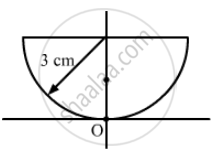
Image shift is given by:
\[∆ t = \left( 1 - \frac{1}{\mu} \right)t\]
\[ = \left( 1 - \frac{2}{3} \right)3\]
\[ = \left( \frac{1}{3} \right)3\]
\[ = 1 \text{ cm }\]
The upper surface of the paperweight is flat and the spherical spherical surface is in contact with the printed letter.
Therefore, we will take it as a simple refraction problem.
Hence, the image will appear 1 cm above point A.
APPEARS IN
RELATED QUESTIONS
You are given prisms made of crown glass and flint glass with a wide variety of angles. Suggest a combination of prisms which will
(a) deviate a pencil of white light without much dispersion,
(b) disperse (and displace) a pencil of white light without much deviation.
What do you understand by the deviation produced by a prism? Why is it caused?
State two conditions necessary for total internal reflection to occur.
Write the relation between the refractive index and critical angle for a given pair of optical media?
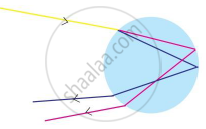
i) Observe the given figure and answer the following questions.
a) Identify and write the natural process shown in the figure.
b) List the phenomena which are observe in this process.
c) Redraw the diagram and show above phenomena in it.
Why do diamonds sparkle?
Can light be ‘piped’ like sound in a doctor’s stethoscope?
Express the refractive index μ of a medium in terms of the angle of incidence i in air and the angle of refraction r in a denser medium.
The adjacent diagram shows two right-angled isosceles prisms A and B. Complete the diagram to show the path of rays P and Q emerging out of the prism B. What principles have you used to complete the diagram?

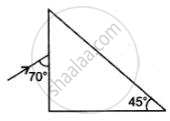
Complete the following diagram to show the path of the ray of a single colour in the diagram as if enters in and emerges out of the prism. Mark the angles wherever necessary. (Critical angle for glass = 42°).
Choose the correct option.
Select the WRONG statement.
Optical fibre communication uses the principle of ______.
A particle is projected such that the horizontal range and vertical height are equal. Then the angle of projection is :
Which of the following statements about total internal reflection is true?
Find the value of θ in the given figure.
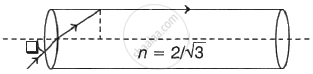
- Assertion (A): Propagation of light through an optical fibre is due to total internal reflection taking place at the core-cladding interface.
- Reason (R): Refractive index of the material of the cladding of the optical fibre is greater than that of the core.
State two differences between normal reflection and total internal reflection.
If even one of the two required conditions for total internal reflection is missing, then:
