Advertisements
Advertisements
Question
Describe the construction and working of an optical fibre.
Advertisements
Solution
Construction:
- An optical fibre consists of an extremely thin, transparent, and flexible core surrounded by an optically rarer flexible cover called cladding.
- For protection, the whole system is coated by a buffer and a jacket
- The entire thickness of the fibre is less than half an mm.
- Many such fibres can be packed together in an outer cover.

Construction of Optical fiber
Working:
- Working of optical fibre is based on the principle of total internal reflection.
- An optical signal (a ray of light) entering the core suffers multiple total internal reflections before emerging out after several kilometres.
- The optical signal travels with the highest possible speed in the material.
- The emerged optical signal has an extremely low loss in signal strength.
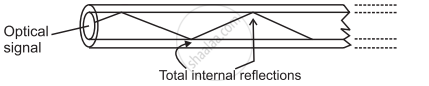
Working of Optical fibre
APPEARS IN
RELATED QUESTIONS
Name two factors which affect the critical angle for a given pair of media. State how do the factors affect it.
State two conditions necessary for total internal reflection to occur.
Write the relation between the refractive index and critical angle for a given pair of optical media?
One day Chetan’s mother developed a severe stomach ache all of a sudden. She was rushed to the doctor who suggested for an immediate endoscopy test and gave an estimate of expenditure for the same. Chetan immediately contacted his class teacher and shared the information with her. The class teacher arranged for the money and rushed to the hospital. On realizing that Chetan belonged to a below average income group family, even the doctor offered concession for the test fee. The test was conducted successfully.
Answer the following questions based on the above information:
(a) Which principle in optics is made use of in endoscopy?
(b) Briefly explain the values reflected in the action taken by the teacher.
(c) In what way do you appreciate the response of the doctor on the given situation?
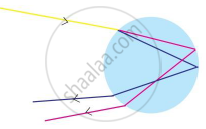
i) Observe the given figure and answer the following questions.
a) Identify and write the natural process shown in the figure.
b) List the phenomena which are observe in this process.
c) Redraw the diagram and show above phenomena in it.
The diagram below shows a light source P embedded in a rectangular glass block ABCD of critical angle 42°. Complete the path of the ray PQ till it emerges out of the block. [Write necessary angles].

Make the correct choices for each of the following :
Total Internal reflection takes place when
(where ∠i = angle of incidence, ∠r = angle of refraction, ∠C = critical angle)
A ray of light incident at an angle of incidence ‘i’ passes through an equilateral glass prism such that the refracted ray inside the prism is parallel to its base and emerges from the prism at an angle of emergence ‘e’.
How is the angle of emergence ‘e’ related to the angle of incidence ‘i’?
The adjacent diagram shows two right-angled isosceles prisms A and B. Complete the diagram to show the path of rays P and Q emerging out of the prism B. What principles have you used to complete the diagram?

A ray of light is incident as a normal ray on the surface of separation of two different mediums. What is the value of the angle of incidence in this case?
Choose the correct option.
Select the WRONG statement.
Which of the following is not involved in formation of a rainbow?
Answer the following question.
Define the critical angle of incidence and obtain an expression for it.
Solve Numerical example.
From the given data set, determine angular dispersion by the prism and dispersive power of its material for extreme colours. nR = 1.62 nV = 1.66, δR = 3.1°
Which of the following statements about total internal reflection is true?
The critical angle is defined as the angle of incidence at which the total internal reflection starts to occur.
Write any two uses of total internal reflection.
The phenomena involved in the reflection of radiowaves by ionosphere is similar to ______.
Observe the given figure of the raindrop and answer the following questions:
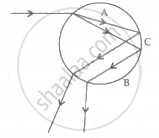
- Label A and B of the given diagram. Why colour will deviate most.
- Name the phenomenon shown in label C.
A ray of light passes through a prism of refractive index `sqrt2` as shown in the figure. Find:
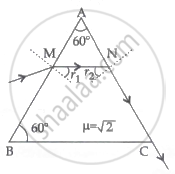
- The angle of incidence (∠r2) at face AC.
- The angle of minimum deviation for this prism.
Small air bubbles rising up a fish tank appear silvery when viewed from some particular angle is due to the ______.
The diagram below shows a fish in the tank and its image seen on the surface of the water.
Name the phenomenon responsible for the formation of this image.
Total internal reflection is defined as the complete reflection of light back into an optically denser medium when:
The critical angle for crown glass, which has a refractive index of 1.52, is:
