Advertisements
Advertisements
Question
Answer the following question.
What are the advantages of optical fibre communication over electronic communication?
Advertisements
Solution
Advantages:
- Broad bandwidth (frequency range): For TV signals, a single optical fibre can carry over 90000 independent signals (channels).
- Immune to EM interference: Optical fibre being electrically non-conductive, does not pick up nearby EM signals.
- Low attenuation loss: loss being lower than 0.2 dB/km, a single long cable can be used for several kilometres.
- Electrical insulator: Optical fibres being electrical insulators, ground loops of metal wires or lightning do not cause any harm.
- Theft prevention: Optical fibres do not use copper or other expensive material which are prone to be robbed.
- Security of information: Internal damage is most unlikely to occur, keeping the information secure.
APPEARS IN
RELATED QUESTIONS
State the conditions required for total internal reflection of light to take place.
The diagram below shows a point source P inside a water container. Four rays A, B, C, D starting from the source P, are shown up to the water surface.
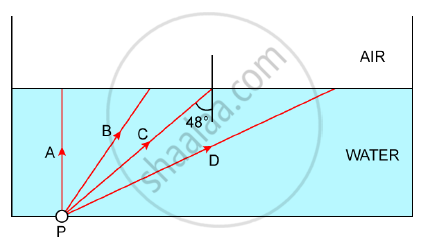
- Show in the diagram the path of these rays after striking the water surface. The Critical Angle for the water-air surface is 48°.
- Name the phenomenon which the rays B and D exhibit.
Draw the diagram of a right-angled isosceles prism which is used to make an invented image erect.
In the given figure PQ and PR are the two light rays emerging from an object P. The ray PQ is refracted as QS.

- State the special name given to the angle of incidence ∠PQN of the ray PQ.
- What is the angle of refraction for the refracted ray QS?
- Name the phenomenon that occurs if the angle of incidence ∠PQN is increased.
- The ray PR suffers partial reflection and refraction on the water-air surface. Give reason.
- Draw in the diagram the refracted ray for the incident ray PR and hence show the position of image of the object P by the letter P’ when seen vertically from above.
Two isosceles right-angle glass prisms P and Q are placed near each other as shown in Fig. Complete the path of the light ray entering the prism P till it emerges out of the prism Q.
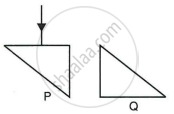
Write the relation between the refractive index and critical angle for a given pair of optical media?
Calculate the speed of light in a medium whose critical angle is 30° ?
Total internal reflection can take place only if ______.
Plot a graph between
Angle of incidence versus angle of reflection,
If a light ray does not undergo, refraction at the boundary between two media, the angle of incidence is:
In the following figure, show two rays A and B travelling from water to air. If the critical angle for water- air surface is 48°, complete the ray diagram showing the refracted rays for each. State conditions when the ray will suffer total internal reflection.
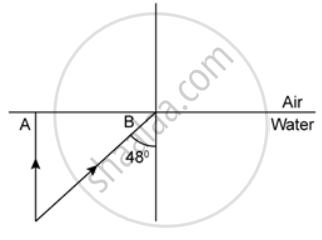
A ray of light incident at an angle of incidence ‘i’ passes through an equilateral glass prism such that the refracted ray inside the prism is parallel to its base and emerges from the prism at an angle of emergence ‘e’.
How is the angle of emergence ‘e’ related to the angle of incidence ‘i’?
A ray of light incident at an angle of incidence ‘i’ passes through an equilateral glass prism such that the refracted ray inside the prism is parallel to its base and emerges from the prism at an angle of emergence ‘e’.
What can you say about the value of the angle of deviation in such a situation?
Draw a diagram, properly labelled, to illustrate the use of a total reflecting prism (a right-angled isosceles prism) to turn a ray of light through 180°. Name an instrument in which this device is used.
Which of the following is not involved in formation of a rainbow?
Answer the following question.
Define the critical angle of incidence and obtain an expression for it.
Observe the given figure and write appropriate phenomenon of light in the box.
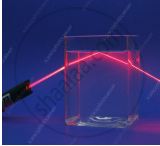
For the same angle of incidence, the angle of refraction in four media A, B, C and D are 25°, 30°, 35° and 40° respectively. The speed of light is least in medium ______.
Which one of the following is NOT the correct formula for refractive index of glass w.r.t. air (aμg) (i = angle of incidence, r = angle of refraction)
The angle of minimum deviation produced by a thin glass prism in air is 'δ'. If that prism is immersed in water, the angle of minimum deviation will be ______.
( aμg = refractive index of glass w.r.t, air aμw = refractive index of water w.r.t. air)
The twinkling effect of star light is due to ______.
The entire light is reflected back into the denser medium is called ______.
Which of the following is used in optical fibres?
The angle made by incident ray of light with normal of the reflecting surface is called ______.
Name any two phenomena which take place in the formation of a rainbow.
Total internal reflection is defined as the complete reflection of light back into an optically denser medium when:
When the angle of incidence for light travelling from a denser medium to a rarer medium is greater than the critical angle, the result is:
