Advertisements
Advertisements
Questions
What is meant by the term ‘critical angle’?
What is a critical angle?
What do you understand by the term critical angle?
Advertisements
Solution
It is the angle of incidence in the denser medium corresponding to which the angle of refraction in the rarer medium is 90°.
RELATED QUESTIONS
State the conditions required for total internal reflection of light to take place.
Draw the diagram of a right-angled isosceles prism which is used to make an invented image erect.
State two conditions necessary for total internal reflection to occur.
Total internal reflection occurs only when a ray of light passes from a ______ medium to a ______ medium.
The diagram below shows a light source P embedded in a rectangular glass block ABCD of critical angle 42°. Complete the path of the ray PQ till it emerges out of the block. [Write necessary angles].

Make the correct choices for each of the following :
Total Internal reflection takes place when
(where ∠i = angle of incidence, ∠r = angle of refraction, ∠C = critical angle)
Why do diamonds sparkle?
Write down the relationship between the critical angle and the refractive index of the medium.
If a ray of light passes from medium I to medium II without any change of direction, what can be said about the refractive indices of these media (angle I is not 0)?
Solve Numerical example.
From the given data set, determine angular dispersion by the prism and dispersive power of its material for extreme colours. nR = 1.62 nV = 1.66, δR = 3.1°
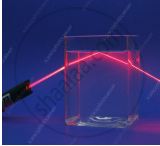
Observe the given figure and write appropriate phenomenon of light in the box.
Critical angle of light passing from glass to air is maximum for ____________.
The twinkling effect of star light is due to ______.
A particle is projected such that the horizontal range and vertical height are equal. Then the angle of projection is :
The critical angle is defined as the angle of incidence at which the total internal reflection starts to occur.
What is a mirage? How does it occur?
A rectangular block of glass ABCD has a refractive index 1.6. A pin is placed midway on the face AB (Figure). When observed from the face AD, the pin shall ______.
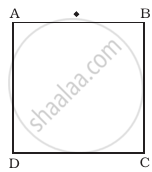
- appear to be near A.
- appear to be near D.
- appear to be at the centre of AD.
- not be seen at all.
Observe the given figure of the raindrop and answer the following questions:
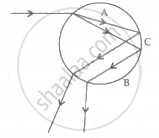
- Label A and B of the given diagram. Why colour will deviate most.
- Name the phenomenon shown in label C.
A ray of light passes from vacuum into a medium of refractive index µ, the angle of incidence is found to be twice the angle of refraction. Then the angle of incidence is ______.
The angle made by incident ray of light with normal of the reflecting surface is called ______.
