Advertisements
Advertisements
Question
A rectangular block of glass ABCD has a refractive index 1.6. A pin is placed midway on the face AB (Figure). When observed from the face AD, the pin shall ______.
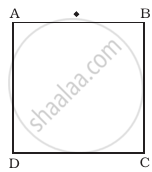
- appear to be near A.
- appear to be near D.
- appear to be at the centre of AD.
- not be seen at all.
Options
a and c
a and d
b and d
c and d
Advertisements
Solution
a and d
Explanation:
As long as angle of incidence on AD of the ray emanating from the pin is less than the critical angle, the pin shall appear to be near A.

When angle of incidence on AD of the ray emanating from pins is greater than the critical angle, the light suffers from total internal reflection and cannot be seen through AD.
APPEARS IN
RELATED QUESTIONS
State the conditions required for total internal reflection of light to take place.
The diagram below shows a point source P inside a water container. Four rays A, B, C, D starting from the source P, are shown up to the water surface.
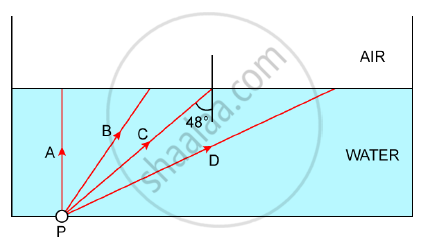
- Show in the diagram the path of these rays after striking the water surface. The Critical Angle for the water-air surface is 48°.
- Name the phenomenon which the rays B and D exhibit.
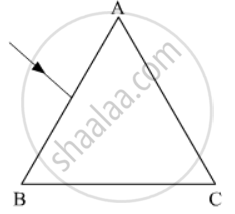
The figure shows a ray of light falling normally on the face AB of an equilateral glass prism having refractive index`3/2`, placed in water of refractive index `4/3`.Will this ray suffer total internal reflection on striking the face AC? Justify your answer.
Plot a graph between
Angle of incidence versus angle of reflection,
Write down the relationship between the critical angle and the refractive index of the medium.
If a ray of light passes from medium I to medium II without any change of direction, what can be said about the refractive indices of these media (angle I is not 0)?
Choose the correct option.
Select the WRONG statement.
Which of the following is not involved in formation of a rainbow?
Answer the following question.
Under what conditions are total internal reflection possible? Explain it with a suitable example.
Answer the following question.
What are the advantages of optical fibre communication over electronic communication?
Answer the following question.
Why is prism binoculars preferred over traditional binoculars? Describe its working in brief.
Critical angle of light passing from glass to air is maximum for ____________.
A green light is incident from the water to the air-water interface at the critical angle (C). Select the correct statement.
The critical angle is defined as the angle of incidence at which the total internal reflection starts to occur.
What are the examples of total internal reflection in nature?
A ray of light incident at an angle θ on a refracting face of a prism emerges from the other face normally. If the angle of the prism is 5° and the prism is made of a material of refractive index 1.5, the angle of incidence is ______.
The angle made by incident ray of light with normal of the reflecting surface is called ______.
The formation of a mirage is explained using:
